Relic point Vietnam
Việt Nam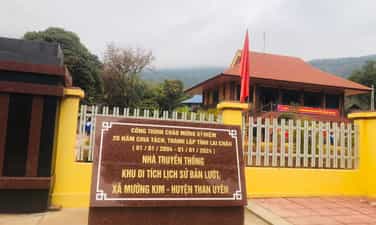
Ban Luong Historical Relic Area
Ban Luot relic in Muong Kim commune is where Lai Chau Provincial Party Committee was born through the Resolution of the 10th Inter-Regional Party Committee on establishing Lai Chau Party Cell. This is the predecessor of today's Lai Chau Provincial Party Committee. On October 10, 1949, the Standing Committee of the 10th Inter-Regional Party Committee established the Lai Chau Party Committee consisting of 3 comrades: Nguyen Ba Lac (alias Tran Quoc Manh) - member of the Yen Bai Provincial Party Committee as a member of the Party Committee, and co-commissioner. Comrade Hoang Dong Tung - Leader of the Lai Chau assault team and comrade Ta Nhat Tuu (alias Hoang Hoa Thuong) - Standing member of the District Party Committee of Lap Thach district (Vinh Phuc) were transferred to Lai Chau as members. In November 1949, the Lai Chau Party Committee delegation led by comrades Tran Quoc Manh and Hoang Hoa Thuong came to Than Uyen and decided to choose Ban Luot, Muong Kim commune (Than Uyen) as the base of operations to advance. to Lai Chau. On December 2, 1949, the Lai Chau Civil Affairs Committee convened a conference to announce the decision of the 10th Inter-Region Party Committee to establish the Lai Chau Cell with 20 comrades, with comrade Tran Quoc Manh as Secretary. This is an important event in the history of Lai Chau revolution, marking the birth of the first party cell of Lai Chau Provincial Party Committee. Ban Luoi is located on Noong Nanh hill in Luot village, Muong Kim commune, Than Uyen district, 4km south of Than Uyen town and 100km southeast of Lai Chau city along national highway 4D and national highway 32. The tourist area The area was invested in building a memorial stele around the village's campus. In October 2003, Than Uyen district was honored by the state to award the title of Hero of the People's Armed Forces during the resistance war against the French. Ban Luoi relic was recognized by the province in 2009 as a revolutionary historical relic. Source: Lai Chau Provincial Youth Union
Lai Chau
7507 view
Rating : Provincial level relics

Na Cung resistance cave
“Na Cung Cave” is located in Na Cung village, Muong So commune - Phong Tho district - Lai Chau province. Before dividing the province in 2004, Na Cung Cave belonged to Ban Na Cung - Muong So commune - Tam Duong district - Lai Chau province (formerly). The relic is located on the top of a low mountain, below is the Tung So field with the wings of a stork flying and the Nam So stream in front of the cave entrance which then flows into the Nam Na stream. Standing in front of the cave entrance, you can see the stream flowing as softly as a young girl's white handkerchief fluttering in the wind. Blending into that is the Tung So field with countless plots, promising bountiful harvests and a prosperous and happy life for the people in the area. Our starting point from Lai Chau Town is along Highway 4D with a flat paved road, winding along the curves of the majestic mountainside. On the way, visitors can enjoy the beautiful natural scenery. The wonderful nature of the mountains and forests has a unique character in the Northwest region. With a length of 23km, we will reach the Phong Tho junction, which is 7km long, and there is still a way to go to Muong So town (from this junction to the commune center, about 3km of flat paved road). When we passed the People's Committee of Muong So commune, we arrived at the central market, where the atmosphere was very bustling. People from many places gather to buy, sell and exchange products to serve life. The atmosphere and pace of life here have given us a change in the bustle of society. When passing the reinforced concrete bridge over the Nam Lum river (market bridge also known as Nang Poong bridge). We continue along the main road about 1km to the junction turning into Na Cung village. With the rustic, pristine road of the community, visitors will have a new feeling of separating from the bustling world to return to a peaceful countryside. With stream banks, fields and countless landscapes, anyone feels much smaller. When visitors reach the suspension bridge over Nam So stream, they can access the culture and daily life of the White Thai community here. It can be said that Na Cung village is one of the first villages of the White Thai people in the whole region, this is one of the cradles of culture, revolution and customs. With traditional stilt houses close together, with streams of water flowing throughout the village... All of these things have complemented and enlivened the wonderful natural scenery and diverse cultural life. When completing the dirt road running along the village, visitors will be surprised when before their eyes opens a majestic scene of endless Northwest mountains and forests, with mountains, rivers, streams, and fields combining together to create into a unified whole, a priceless colorful picture of nature. It is here that visitors can reach the historical and cultural relic and scenic spot Na Cung Resistance Cave. Source: Lai Chau province electronic information portal
Lai Chau
5840 view
Rating : Provincial level relics

Muong Te Fort
Muong Te Fort was recognized as a provincial-level historical and cultural relic on December 31, 2008. The relic is located on "Phu Don" hill, which is the station mountain in Nam Cum village - Muong Te commune - Muong Te district - Lai Chau province. Built on the top of a quite high and dangerous hill, located between the junction of the Nam Cum suei and the Da river, it is very convenient for observing all four directions and the escape route to the Da river to Mu Ca when attacked. In April 1980, the French colonialists occupied the entire province of Lai Chau after gradually suppressing the uprising movements of the French colonial people and began building a ruling apparatus with many sinister plots and tricks. Many people in Chau and Meng became lackeys for the French colonialists. On March 27, 1916, the French colonialists established the 4th army of Lai Chau including: Lai Chau, Chau Quynh Nhai, Agency Department and Chau Dien Bien; Northern border areas include: Muong Te, Muong Nhe, Muong Bum (Muong Te), Mao Xa Phin (Sin Ho). According to Decree No.: 2016 dated September 6, 1917 of the Governor-General of Indochina, the stations in A Pa Chai and Muong Te were established and commanded by the French and local people were responsible for guarding to ensure security for the people. Northern border area. In 1929, the governor of Tonkin allowed the grouping of three border areas: Muong Te, Muong Nhe, Muong Bum into an administrative group under the control of a French lieutenant commanding the Muong Te post. , from then on, local people often call this Muong Te station. Source: Department of Culture, Sports and Tourism of Lai Chau Province
Lai Chau
5608 view
Rating : Provincial level relics

Historical Relic of Le Thai To Stele (Le Loi)
The temple complex of King Le Thai To and King Le Thai To's stele is located 110km southwest of Lai Chau city center, in the administrative territory of Le Loi commune and Pu Dao commune, Nam Nhun district, Lai Chau province. The temple was built to commemorate the merits of national hero Le Loi, who had the merit of quelling the rebellion in the Northwest region. The temple is located on a prime, high location, with views from all four sides. At the King Le temple complex, there is also a precious relic, the Le Loi stele relic. In December of the year Tan Hoi (1431), King Le Thai To had it engraved into the Pu Huoi Cho cliff on the north bank of the Da River to preserve it for future generations. Old history called it "Ancient stele of nostalgia". The stele records the historical event of King Le Thai To personally commanding troops to suppress rebellion in the Northwest region of the country. That was the event in 1431, the chief Deo Cat Han rebelled, allied with Kha Don (also known as Kha Lai) - a rebellious servant of Ai Lao (Laos) to harass the people on the border, and invaded. Muong Muong land (now Thuan Chau - Son La region today). Due to the rebellious actions of Deo Cat Han, King Le Thai To sent King Tu Te and military officer Le Sat to attack. After that, King Le Thai To personally led his army to Phuc Le district (Ninh Vien district). The imperial army advanced along the road from the Red River, then up the Da River, by water and road, defeating the rebels at Cat Han Pass. When the king's army reached Deo Cat Han's lair, Kha Lai and Deo Cat Han fled, then the People captured Kha Lai and killed him. December of the year Tan Hoi - 1431, after pacifying the Northwest region, on the way back through Le Loi commune, Nam Nhun district (currently), to remember this important event and at the same time teach prisoners The leader of the country's borders, King Le Thai To had a poem carved into the cliff. The stele engraved with a poem by King Le Thai To that remains today is an extremely valuable cultural heritage. The stone stele or rather a golden page of history against foreign invaders and greedy chiefs who colluded with foreigners to fight against the feudal state of Vietnam at that time. In 2005, Son La Hydroelectric Plant started construction. To avoid being flooded, the inscription and stele of King Le Thai To were relocated. After being drilled, the autograph was cut into a large block of stone measuring 2.62m long, 1.13m wide, 1.85m high, and weighing over 15 tons. In 2012, Le Loi stele was moved from the Pu Huoi Cho cliff to the temple grounds of King Le Thai To, 500m from the old location. Le Loi Stele Relic was recognized as a national historical site on September 2, 1981. At the end of 2016, Le Loi Beer was officially recognized as a National Treasure. In early 2017, King Le Loi Temple was also ranked as a national historical relic by the Ministry of Culture, Sports and Tourism on January 23, 2017. Source: Lai Chau province electronic information portal
Lai Chau
8121 view
Rating : National monument

Nam Tun archaeological site
Nam Tun archaeological site was excavated in Nam Tun cave, Phieng Danh village, Muong So commune, Phong Tho district, now Phong Tho town, Lai Chau province. Before 1945, Nam Tun cave was called Tham Ho Khoai - meaning Buffalo Cave. Nam Tun archaeological relic excavated in 1973, the cultural layer is 1.8 m thick with two layers. The upper layer has ground stone axes, pottery and 3 graves (still retaining remains) typical of the late Neolithic period. The lower class found nearly 200 large, rough-hewn pebble tools, over 700 scrap pieces and 2 graves typical of the late Paleolithic period, representing the oldest cave archaeological relics in the Northwest. belongs to the Son Vi culture. Nam Tun cave site is the residence, burial and tool making of two classes of people, with two cultural layers, the pre-Neolithic period and the post-Neolithic period. In Nam Tun cave, there are 5 ancient tombs and many ancient relics, especially bone awls, found for the first time in Vietnam. Nam Tun Cave is in a quite favorable location. The cave entrance looks west. In front of the cave is a large stream, today people here often call it Nam Phe village (Nam Phe is not more than 100 m from the cave entrance). During the flood season, the stream rises and floods the valley surrounding the cave. The valley is clearer today, and from there, villages of Chinese and Thai people living side by side have sprung up. Nam Tun Cave has a very complex structure. There are places where stalactites are thickly covered. There are places where the stalactites are only coated in a thin layer. This layer is about 0.15m to 0.20m thick. Here you can find cultural relics of many different eras. Full-body grinded axes, ceramic pieces that, although rough, were made on a turntable, decorated with engraved patterns, rope patterns..., a double-edged stone mold, a green bead made of jade - All of them, if the earliest, belong to the late Neolithic period. Through the layer of large pebbles, there is a layer of dark brown soil mixed with many gravels. Here, many crudely hewn pebble tools were found, with different weights and sizes, without a stable shape. Many large scrap pieces were found, products of the tool making process by the hewn method. direct. Nam Tun cave archaeological relic was ranked as a National Archaeological Historical Monument on February 7, 2013. Source: Lai Chau province electronic information portal
Lai Chau
7479 view
Rating : National monument
Deo Van Long mansion
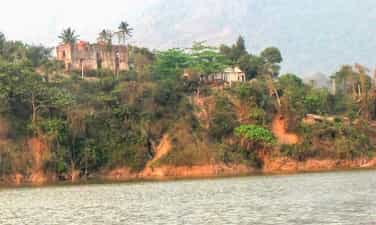
Deo Van Long mansion is located in Le Loi commune, Sin Ho district, Lai Chau province. According to the 1983 survey results of the Department of Culture and Information of Lai Chau province, this project began construction in 1916. The documents left behind about the mansion and the Deo family are still very primitive, but They all believe that all the work of choosing the direction, choosing the location for the main gate, the shrine, and the Dam house (ancestral church) were carefully considered by the Deo family, who hired a geographer. Two architects, one French and one Chinese, were invited to design and supervise, and materials were brought from the lowland provinces. Therefore, the architecture of the mansion has Western features blending Eastern looks, and is also a characteristic of Thai construction art and feng shui. The mansion has an area of about more than 1 hectare. Due to the need for defense, welcoming Indochina Government officials and to satisfy their luxurious lifestyle, the Deo family gathered people, soldiers, and workers for the job. Build a villa complex, located in a critical location, at the junction where the Da River, Nam Na River and Nam Lay Stream meet. Behind the mansion is a high mountain, in front is a confluence of rivers (Da River, Nam Na River and Nam Lay Stream) that can control the road to Phong Tho, Muong Te and down to Hoa Binh, Son La, as well as For example, through Dien Bien to Laos, the terrain is suitable for defending and fighting against the enemy. If they fail, they can retreat safely. In 1918, the mansion was completed with 8 main units: Main gate, Dam house, dining room, swing house, water tower, prisoner cellar, forest ghost shrine and another house with L-shaped face ( unknown purpose). In addition, there are a number of other supporting works such as surrounding walls, side gates, driveways leading to the main gate, long and narrow steps leading down to prisoners' cellars, granaries, boat docks, and cemeteries. The main house is built with two floors of red bricks, wooden floors, and a tiled roof separated from stone slabs, often called black stone (when first separated, the soft stone can be cut with a knife, but when exposed to sunlight, the stone will hard as porcelain). Surrounding the castle is a wall over 3m high, built of 40 to 50cm thick slate, very sturdy, with many battlements on the wall to observe the outside. In front of the main house, there is a large yard for dancing when Deo Van Long holds parties and receives guests. It can be said that the palace complex is an "impregnable fortress" of the Thai king. Speaking of Deo Van Long, he is the second son of Deo Van Tri and a lord of the Thai Autonomous Region in the Indochina Federation. The Deo family comes from an aristocratic lineage in Yunnan (China). They are not reactionaries but have lived together in harmony on the land of Lai Chau for a long time. In the late 19th century, responding to the Can Vuong movement, the Deo family stood side by side with the Black Flag insurgents to defend Son Tay and achieved many victories. However, after huge losses in the decisive battle along with suspicion and lack of internal unity, Deo Van Tri signed a permanent ceasefire treaty with the French army. Protected by the French Government, supported with money and weapons, France restored Deo Van Tri to govern the land of Sipsong Chuthai (12 Thai lands). In 1908, Deo Van Tri died, handing over military power to his son Deo Van Khang. After Khang died, Deo Van Long replaced his brother to take power. From here, with his brutal nature, Deo Van Long spread terror to the people in the area. In addition to sending soldiers to plunder and loot the wealth of the people in the area, the Thai king also built large boats, using the Da River as the main transportation axis to transport forestry and land products that he had robbed from the local people. They went to the lowlands to sell opium, tiger skins, leopard skins, bear bile, etc. then brought the goods up to sell to local people. After the liberation of Lai Chau town (1952), Deo Van Long fled to France in exile, and the mansion was destroyed by the people. Up to now, the entire mansion has become ruins, many buildings have been completely lost and the original architectural shape cannot be determined. In 1980, the Deo Van Long mansion was decided by the People's Committee of Lai Chau province to be classified as a provincial relic and included in the restoration plan. However, since 2010, the Son La hydroelectric project has accumulated water, part of Deo Van Long's mansion has been permanently sunk into the river bed, leaving only a few ruins. Source: Lai Chau Newspaper
Lai Chau
6643 view
Rating : Provincial level relics
Indochina junction
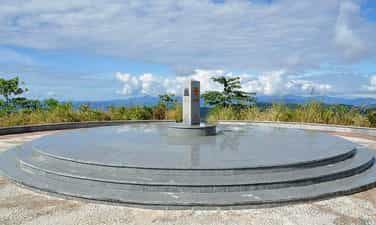
The Indochina junction is not only famous during the resistance war against the US, but today this place is becoming very attractive to tourists on their journey to visit Kon Tum - the northernmost tip of the Central Highlands of Vietnam. The place of the Indochina junction on the majestic Truong Son range has always been in the memories of soldiers and young volunteers on their way to the Southern battlefield, battlefield C (Laos), battlefield K (Cambodia) over the years. Unforgettable war. This is the land known as the rooster crowing that all three countries hear together. Now this land is becoming one of the attractive tourist destinations for domestic and foreign tourists. Where places have gone down in history such as the Indochina junction (where Truong Son West road meets Truong Son East road during the resistance war), historical relics of the victory of Dak To - Tan Canh in April 1972; The border marker was jointly built by the three brother countries Vietnam - Laos - Cambodia on a mountain top 1,000m above sea level, about 30km from Playku town. This milestone was constructed by Kon Tum province in December 2007 under the supervision of experts from three countries sharing a common border. Representatives of the three countries' Ministries of Foreign Affairs held a solemn inauguration ceremony on January 18, 2008. The special milestone weighs 900 kg, is made of triangular cylindrical marble, is 2 meters high, and on each side of the milestone facing each country is attached the national emblem, the year the milestone was installed and the country's name in red letters of the government. that country. This is the second milestone marking all three countries to be placed on Vietnamese soil. The first milestone is the unified construction of the three countries Vietnam - Laos - China in A Pa Chai (Dien Bien). From the border junction marker, visitors have the opportunity to see the panoramic view of the Indochina junction land. Also here, tourists who want to visit Laos and Cambodia can complete exit procedures at the Vietnam border station at Bo Y international border gate. Source: Kon Tum Tourism
Quang Ngai
6099 view
Rating : National monument

Chu Mom Ray National Park
Chu Mom Ray National Park is located in Sa Thay and Ngoc Hoi districts (Kon Tum province). Right next to Chu Mom Ray National Park is Cambodia's Virachey National Park and Laos' Southeast Ghong Conservation Area. The flora of Chu Mom Ray National Forest is rich and diverse in species and status. There are about 1,534 plant species here, including 113 rare species belonging to the orchid family, gymnosperms, dioecious species, cycads, cycads, bamboo pine, rosewood, rosewood... The fauna of Chu Mom Ray National Park records 718 species, including 115 species of mammals, 275 species of birds, 41 species of reptiles and amphibians, 108 species of freshwater fish, and 179 species of insects. Among them, there are 124 rare species listed in the Red Book of Vietnam and the world, typically: red-cheeked gibbons, Truong Son muntjacs, gaurs, Indochinese tigers, elephants, black bears, fire leopards..., false lizards. 4 new stripes, white-edged snake, daisy-fronted snake..., hornbill, peacock, earth eagle... This place once marked many fierce battles during the period of "cutting Truong Son to save the country". Some places in the forest still have traces of trenches, bomb craters... The total area of Chu Mom Ray special-use forest is about 54,583.59 hectares; production forest 1,665.64 hectares; buffer zone 188,749 hectares. Including Bo Y and Sa Loong communes (Ngoc Hoi district); Ro Koi, Sa Nhon, Sa Son, Mo Rai, Ya Xier, Sa Thay town (Sa Thay district. This is where ethnic minority communities live, notably the Gia Rai and Ro Mam people. The proud point of the National Park is that there are 114 species in the Vietnam and world red books. In particular, the grassland (Ja Book valley) is the largest in Vietnam (more than 9,000 hectares) and has attracted many important species of ungulates and carnivores such as Truong Son muntjac, wild buffalo, tiger, etc. gaur, bison, elephant, black bear, fire leopard... and hundreds of species of reptiles and amphibians. In addition, on high mountain peaks such as Ngoc Linh, Ngoc Tu Ba, Chu Mom Ray peak... are home to many species of primates and arboreal animals such as gibbons, langurs, and precious birds such as hornbills. , land eagle, peacock… This is one of 94 special-use forests in Vietnam, with the largest area of primary forest and containing rare genetic resources. In 2004, Chu Mom Ray National Park was recognized as an ASEAN Heritage by the Association of Southeast Asian Nations. Source: Vietnam National Tourism Administration
Quang Ngai
5890 view
Rating : National monument

Mang Den historical relics and landscapes
Mang Den eco-tourism area is located in Mang Den town, Kon Plong district, Kon Tum province. Mang Den is a cluster of enemy strongholds, located on Road 5 from Kon Tum to Quang Ngai, now Highway 24, about 55 km northeast of Kon Tum city. This is a cluster of enemy bases deep in our liberated area. Surrounding the base is a complex system of dense obstacles with 10 layers of barbed wire and 2 layers of fence. Alternating between the layers of fence are anti-infantry mines, anti-tank mines and a trough-shaped trench 4m wide, 2.5m deep, densely planted with spikes. Inside were hundreds of blockhouses made of reinforced concrete and earthen wood, with tunnels connecting the fortifications and three corners with three mother blockhouses made of solid reinforced concrete. In mid-1974, the Kon Tum Provincial Party Committee and the B3 Command advocated attacking and destroying enemy bases to expand the liberated area and create momentum for the temporarily occupied Kon Tum area. After a period of preparation, at exactly 5:30 a.m. on October 3, 1974, the Commander of the 28th Infantry Regiment, Division 10, Army Corps 3 ordered to open fire to attack the enemy headquarters. At 7:55 a.m., our firepower simultaneously hit all targets. After a short time of developing the attack, at 10:45 a.m. we completely took control of point M12. Faced with the attack power of the H16 and H29 forces, the main force of the 28th Infantry Regiment and a number of our technical troops, on October 12, 1974, the enemy's last stronghold was located deep in the settlement area. The project in the Northeast of Kon Tum was completely wiped out. With the Mang Den victory in October 1974, our troops destroyed the enemy's last stronghold deep in our liberated area, breaking the enemy's safe corridor in the north of Kon Tum town, causing enemy troops to in the Northern Central Highlands battlefield was under strong threat. This victory liberated thousands of people and a large area of land, which was a great encouragement to promote the revolutionary actions of the people, especially ethnic minorities; At the same time, consolidate and build strong local government and armed forces. On the verge of victory, the armed forces surrounded the district capital of Mang But, liberating all the people in the area. Along with the victories at Dak Pet and Mang But bases, the Mang Den victory contributed to expanding the liberated area to Kon Tum town, creating new position and strength for the Central Highlands campaign, paving the way to liberate Saigon. , successfully ending the historic Ho Chi Minh campaign, unifying the country. Mang Den historical and scenic area was recognized as a national historical and scenic site on April 13, 2002. Source: Kon Tum Tourism
Quang Ngai
8423 view
Rating : National monument
Kon Hrinh evidence area
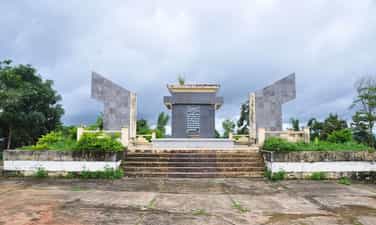
The evidence area of Kon Ho ring Church in Kon Ho ring village, Dien Binh commune, Dak To district, Kon Tum province is a place that marks the crimes of the American imperialists and the Saigon puppet government. Here, on the night of May 25, 1972, the US imperialists and the Saigon puppet government used planes to bomb and bomb the Kon Ho ring church and monastery, killing 500 innocent people and killing hundreds more. injured. More than 10 years ago, to commemorate the people who died due to the crimes of the American imperialists and the Saigon puppet government, Kon Tum province invested in building the Kon Ho ring Church relic area. The project is solidly built, with many main items such as: Memorial stele with content reflecting the crimes of the enemy, green campus, fence... After completion, the Kon Church Relics Area Ho ring has become a destination for local people as well as tourists inside and outside the province. Kon Ho ring Church is an outstanding religious architectural work in Dien Binh Commune, Dak To District, Kon Tum Province. Built in 1959, this church is the gathering place of the K'ho community, an ethnic minority living mainly in Kon Tum. Kon Ho ring Church stands out with its unique architecture, inspired by the traditional culture of the K'ho ethnic group. The temple roofs are made from bamboo and coconut leaves, creating a wild, rustic beauty that is no less impressive. Inside the church, paintings and statues of saints are carved on wood, creating a sacred and solemn atmosphere. Kon Ho ring Church is not only a gathering place for religious ceremonies but also a place to attract tourists and those who love culture and architecture. Visitors coming here will be able to visit, learn about the culture and history of the K'ho ethnic group and also have the opportunity to experience their life. In addition, Kon Ho ring Church is also a place where you can learn about the spiritual life of local people, as well as participate in religious activities such as festivals, seminars, and learn about ethics and lifestyle. nation's life. With its beauty and special historical and cultural value, Kon Ho ring Church has become a tourist destination not to be missed when you come to Kon Tum. Take time to explore and experience the feeling of peace and quiet at this location. Surely you will have memorable and meaningful experiences when you come to Kon Ho ring Church. Source: Kon Tum province information portal
Quang Ngai
5920 view
Rating : Provincial level relics