Relic point Vietnam
Việt Nam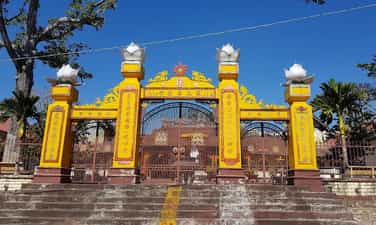
Bac Ai Pagoda
Bac Ai Ancestral Pagoda is located on Mac Dinh Chi street, Quyet Thang ward, Kon Tum city. The pagoda was built in the 8th year of Bao Dai (ie 1932 to 1933). Located on a high ground, the pagoda faces south, following Hue architectural style, Mon-shaped, including the Main Hall, Dong Lang, Tay Lang and Three Entrance Gate. Leader Vo Chuan, designed and urged both Kinh people and ethnic minorities to explore the jungle hill to build a pagoda, designed in the style of the word "Mon". In the year of the Goat, 1931, the Central provinces suffered consecutive droughts and crop failures, and people were hungry. Therefore, in the late years of 1931 and 1932, immigrants from the provinces of Hue, Da Nang, Quang Nam, Quang Ngai, and Binh Dinh flocked to the highlands and Kon Tum. During this migration, 70% died of starvation along the way, the remaining 30% reached the promised land. They cleared the forest for farming, but in this place they encountered many unforeseen things: wild animals, raging cobras biting countless people to death, people were confused and scared, night and night in this land, things happened. Many scary phenomena occurred. In 1932, Director Vo Chuan invited Mr. Hoang Thong, head of Bach Sa Pagoda, Quy Nhon, and the monks to go to Kon Tum to fast for 3 days to pray for the souls of unjustly deceased people. After the funeral ceremony, Mr. Vo Chuan asked Mr. Hoang Thong to prove his name Bac Ai. Charity is immense love, regardless of religion, Kinh people or Upper people. The pagoda was given the sign "The Four Bac Ai Tu" by King Bao Dai in 1933. In 1990, the pagoda was restored with the organization of the Venerable Abbot Thich Chanh Quang. Looking at the overall architecture, Bac Ai Patriarch Pagoda was built in the North-South direction, in Mon style, opening for that direction is the three-entrance gate, leading to the main hall in the center and the left and right sides are Dong Lang and Dong Lang. Tay Lang. The main hall consists of 3 rooms and 2 wings. The ancient building is divided into 3 compartments: front hall, middle hall, and upper hall. The roof is tiled, the brick walls are whitewashed, and the ceiling is covered with ceilings. The rafters, rafters, and columns all use precious woods such as purple star, rosewood, and redwood, elaborately and elaborately carved by Hue artisans. This space worships Tam The Buddha, Amitabha Tam Ton, Hoa Nghiem Tam Thanh... In particular, there is a stele recording the merits of French Captain Quenin and a wooden pillar symbolizing the 7 skulls of a Japanese officer who committed suicide at the pagoda yard at the end of World War II. Outside the main hall is Hoa Vien, where tombstones, towers, and shrines worship the God Emperor Bon Canh, Mountain God, Doan Quan and tru house are concentrated. Through many restorations, Bac Ai Ancestral Pagoda's original architectural features have been changed, and some unique sculptures such as flanking dragons and winding ropes are no longer there. The system of worship statues is covered with a layer of bright bronze, unable to retain its pristine beauty. However, a number of precious artifacts with visual artistic value such as the Statue of the Three Holy Mother Goddesses, the Guan Yin statue made of cracked ceramic, the Hoang Phi, the Couplet, the Ordination box, the Seal, etc. are still on display. subtle traces of time. Currently, Bac Ai Ancestral Pagoda is one of three communal houses (Vo Lam Communal House, Trung Luong Communal House, Bac Ai Ancestral Temple) that have been recognized by the People's Committee of Kon Tum Province as a historical-cultural relic. provincial level Source: Kon Tum Tourism
Quang Ngai
6269 view
Rating : Provincial level relics
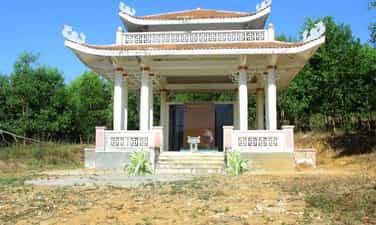
Plei Kan victory
Plei Kan is located in Ngoc Hoi district, Kon Tum province. It is located in the north of Kon Tum province, on the eastern slope of the Truong Son range. A special feature of Plei Kan is that it is located at the crossroads of three countries: Vietnam, Laos and Cambodia. Plei Kan has an important history during the Vietnam War. Before 1965, Plei Kan was a large village of the Xe Dang ethnic group and other ethnic groups such as Brau, H Lang, and Kdong. Its strategic geographical position was recognized at the end of 1964 when the US decided to build a cluster of military bases here. Plei Kan in the language of the Xe Dang people is "big village". Before 1965, this was a place where the Xe Dang and Brau people lived in harmony in a peaceful village at the cross-border area of the three countries Vietnam - Laos - Cambodia. At the end of 1964, realizing the important strategic position at the Indochina border junction, the US puppet implemented a policy of gathering people to set up hamlets to isolate the people from the revolutionary forces, herding people to Dak Rnang village (Tan Canh, Dak To) established a strategic hamlet. In 1966, the US built Plei Kan into a military base located in the Indochina junction area (we often call it Plei Kan Base) to block the attack of our main army from the North and from Laos and Cambodia. The entire base has areas A, B, C, D, E, arranged continuously on 5 hills separated by 600 - 1,000 meters. In particular, area A is the central area. There is a tank detachment, a military airport, a field airport, 155mm and 105mm artillery positions, a system of underground bunkers, bunkers, hospitals, warehouses... The base is surrounded by 8 to 12 layers of barbed wire. Since 1969, here, there have been regularly 450 - 500 border rangers (95th Border Ranger Battalion) and 2 artillery companies of E 42 (Division 22) of the puppet regime. In early October 1972, the Central Highlands Front Command assigned the 10th Division the task of destroying Plei Kan Base. The 66th Regiment, the 37th Special Forces Battalion and most of the Division's artillery were ordered to attack. At 10:00 a.m. on October 12, 1972, from the surrounding artillery positions, our artillery continuously opened fire. All types of D74, 105mm, 155mm DKZ, B72 artillery, 106mm mortars... simultaneously bombarded targets in the base. Under the support of infantry, artillery and special forces, they cut the fence and opened the door. At 11:00 a.m., with strong support from artillery, tanks and infantry, we heroically rushed forward to capture the targets. The fighting in the base was extremely fierce. We and the enemy fought over each bunker, bunker, fortification... With a brave and tenacious spirit, after nearly a day and night of fighting, by dawn on October 13, 1972, we had complete control of Plei Base. Kan. As a result, we killed 404 enemies, captured 65, shot down and destroyed 6 aircraft, captured 6 105mm guns, 2 155mm guns, 4 tanks and the entire ammunition warehouse. With the victory at Plei Kan Base, we have completed the liberated area north of Kon Tum, opened the Indochina border corridor, and our strategic transportation route from the great rear of the North to support the battlefield. The South via the Ho Chi Minh Trail became a solid continuous system and liberated tens of thousands of people. Today, the Plei Kan victory relic site is located on the Ho Chi Minh Highway, in Dak Xu commune (Ngoc Hoi district). Plei Kan Victory Historical Relic was ranked at National level on May 15, 2024. Source: Kon Tum province electronic information portal
Quang Ngai
6428 view
Rating : National monument
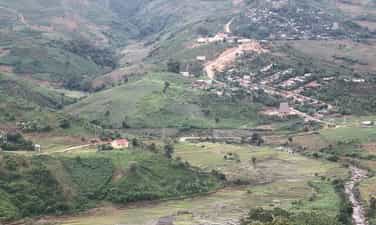
Kon Tum Provincial Party Committee Base relic area
The revolutionary historical relic area of Kon Tum Provincial Party Committee Base is located in the Northeast of Mang Ri commune, Tu Mo Rong district, Kon Tum province. It is one of the bases with a very important position and strategic role in the resistance war against the US to save the country of Kon Tum Province in particular and the Central Highlands in general. The base was built, consolidated and developed in a very favorable area. located in the revolutionary heart of the Xo Dang ethnic population. This place has a very complicated divided terrain, with a continuous system of hills and mountains located in the Ngoc Linh mountain complex, with high mountains and extremely dangerous deep streams, making it very difficult for the enemy to detect. attack us. But on the contrary, this is a very convenient area for us in terms of communication system, located at the northern tip of the Central Highlands, the gateway connecting to the Socialist North, where our bases and basic areas are adjacent. from all directions in the province. On that basis, it creates favorable conditions for us in the process of moving as well as in the process of attacking or retreating to defend. Because of such favorable conditions, the Provincial Party Committee stood up to operate and direct the struggle during the period from 1960 to 1972. In early 1955, the Kon Tum Provincial Personnel Committee moved to Kon Po Oai and Kon Po E (Po E commune), then moved to Dak So Lo and then moved back to Nuoc Che (now in Ngoc Tem commune, Kon Plong district), stabilize the organization and direction, and urgently promote the shift in ideology and organization to suit the new situation. At the end of 1959, the Kon Tum Provincial Party Committee moved its agency to H80 (now Tu Mo Rong district) located in Mo Gia village, Mang Ri commune to promptly direct the struggle movement in the coming period. Because the terrain H29 (Kon Plong) is remote, the direction is difficult and timely. So the Kon Tum Provincial People's Committee chose the location at Dak Y Hai stream in Mang Ri commune as a base, because this is a strategic military as well as political area, behind the mountain range. Majestic Ngoc Linh Mountain with an altitude of 2598m is located to the north, to the east is the base of the Party Committee of Zone 5. This area creates a convenient traffic corridor for routes from east to west. In addition, this is also a strategic area for agricultural economic development of wet rice cultivation along two streams Dak My (H30) and Dak Posy (H80). There is also a fairly flat valley with good soil. Providing food sources for the Provincial Party Committee's long-term operations. Moreover, the people here are very good, over 70 villages are of the Xo Dang ethnic group, our revolutionary base where no puppets come. To stabilize long-term operations and direction, at the beginning, the Provincial Party Committee built working departments with rudimentary materials such as bamboo, wood... with large areas. The area of each room is 25m to 30m square. In addition, to ensure safety and prevent bombs and bullets when the enemy detects them, the Civil Affairs Committee also equips a system of trenches and shelters surrounding the working area of the Secretary and Deputy Secretary of the Office. Provincial Party Committee room, logistics, cipher department... And are arranged quite methodically in a closed, continuous system stretching from north to south along the hillside at an altitude of 1922.6m located in the heart of two streams. Dak Y Hai stream is large and Dak Y Hai stream is small. Here, the Provincial Party Committee successfully directed 4 Provincial Party Congresses (from the 1st Congress, March 9, 1960 to the 4th Congress, October 26, 1971), setting out important decisions, Directing the army and people of all ethnic groups in Kon Tum province to fight against the Americans and save the country, such as: Deciding on an order to start a march to gain control over the countryside; General offensive and uprising during the Tet Offensive (1968); Dak To - Tan Canh Campaign, moving towards liberating Kon Tum province... In addition, the Provincial Party Committee has mobilized the strength of ethnic groups and people from all walks of life, mobilized the masses, and well implemented core contents with people as the basis. On that basis, during the struggle against the US, people of ethnic groups in the base areas such as Ngoc Lay, Te Xang, Mang Ri... actively participated in all activities. Among them, especially the people of Mang Ri commune contributed 4,000 working days, participating in the fire line, carrying rice and ammunition. People's cadres and armed forces of the commune's militia and guerrillas directly participated in 17 large and small battles, destroying and disintegrating two American and puppet battalions, and destroying many enemy war vehicles. Transported and protected hundreds of officers from above to return safely, received and nurtured many key units of the Province and military zones during the gathering in the commune. Sharpened 5 million spikes and arranged hundreds of spike holes, made homemade weapons to fight the enemy, contributed to the revolution each year 600 baskets of rice, 5,000 wheat stalks, hundreds of buffaloes, cows, pigs, chickens and tons of other food… The Provincial Party Committee Base relic will forever be a red address, a symbol of the revolutionary loyalty of the army and people of Kon Tum province. With that historical significance, the Kon Tum Provincial Party Committee Base Relic (period 1960-1972) in Mang Ri commune, Tu Mo Rong district was ranked a provincial historical relic by the Kon Tum Provincial People's Committee on August 2, 2019. 2007. Source: Kon Tum province electronic information portal
Quang Ngai
6146 view
Rating : Provincial level relics
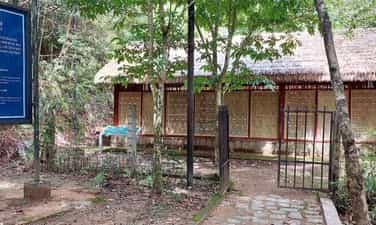
Dak Glei Prison
Dak Glei Prison belongs to Dak Choong commune, Dak Glei district, Kon Tum province. The Dak Glei Prison historical relic cluster includes three small works: The guard post area, Can An Tri area and the Prison area. The entire relic area is located on hills, surrounded by high mountains, streams, and valleys. Dak Glei Prison was built by the French colonialists in 1932, where Vietnamese revolutionary soldiers were detained in the years 1932 - 1954. At the same time, the colonialists also quarantined influential revolutionary activists. with a plot to control the entire Central Highlands. Initially, Dak Glei prison only detained people who did not submit to the ruling policies of the French colonialists and their henchmen. But since the end of 1939, the French colonialists have turned this place into a place to imprison communist soldiers after intensifying the repression of the revolutionary movement. Not only is it the place where famous revolutionary poets like To Huu were imprisoned, this is also where many key Party figures were arrested such as Nguyen Duy Trinh, Chu Huy Man, Huynh Ngoc Hue, Le Van Hien, Tran Van Tra , Le Ba Tu, Ha Phu Huong and Nguyen Tat Thang. Dak Glei Prison is a rectangular architectural work, consisting of one floor, an area of about 200m2, 19.85m wide, 10.2m deep, including 4 rooms. Located opposite Dak Glei prison through a yard about 20 meters wide is a one-story house with 2 small rooms, also built of stone, the outer room is the guard station, the other is the kitchen. From Dak Glei prison, going down the hillside about 150m is a "solitary prison" about 12m2 wide, built from February to June 1942 right after the escape of two patriotic revolutionaries, To Huu. and Huynh Ngoc Hue. In this prison, the space is both stuffy and gloomy, full of chains and shackles... Located between the prison and the station area is the An Tri prison with rows of prison cells built of bamboo and wood. Each prison has a stall for prisoners to lie down with their heads facing the middle, their feet shackled to the outside, each stall holds about 20 prisoners. In the evening, guards often count feet to check the number of prisoners. Because it was only built of bamboo and unstable wood, the An Tri stretch area currently has no traces of the construction due to differences between recorded documents, and it is impossible to estimate the exact number of 2 or 3. female. Dak Glei Prison is also known by Kon Tum people by another familiar name, To Huu Prison, because during the anti-French period, this was the place where the famous revolutionary and poet To Huu was imprisoned. This place is associated with the spectacular prison escape story of poet To Huu here. Specifically, in early 1942, To Huu and comrade Huynh Ngoc Hue planned to escape from prison. After that event, the French colonialists terrorized other communist soldiers and arrested our people's comrades in An Tri camp and imprisoned them. Today, the relic site has been being restored and renovated, the road system to the relic has also been invested and built smoothly, worthy of being a revolutionary red address, with great educational significance, a A proud symbol of the resilient fighting spirit of revolutionary soldiers. On December 30, 1991, the Ministry of Culture, Sports and Tourism recognized Dak Glei Prison as a National Historical Site. Source: Kon Tum province electronic information portal
Quang Ngai
6156 view
Rating : National monument
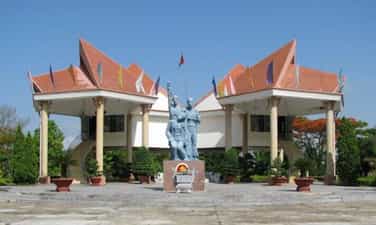
Kon Tum Prison
"Kon Tum Prison" is located at Truong Quang Trong Street, Quyet Thang Ward, Kon Tum City. "Kon Tum Prison" reflects an early historical period of the movement to fight against invaders in our country. Kon Tum Prison was built by the French colonialists from 1905 to the end of 1917. Kon Tum Prison was built next to a large ditch next to the prison on the East-North side of Street 14 (now Phan Dinh Phung Street - Ho Chi Minh Highway running through Kon Tum city); West - South is the green loincloth soldier station; East - South is the embassy, the puppet leader's palace, and the Police Department. They placed Kon Tum Prison under siege and isolation. To facilitate control, they dug a deep trench 150m long, 100m wide, designed four rows of houses in a box shape (square) with an area of about 2.5 hectares, four corners of the prison had 4 bunkers built up, guarded day and night. secure room. The prison is built in the style of the old French fortress Vauban (Vo-ice) of the 17th century. The roof is tiled, the walls are made of whitewashed tocsi, the four sides are not covered by walls like other prisons, four cells are vertical and horizontal. built together into a square, each 18m side has a door and two high huts so the guards can observe inside and outside the prison; In the middle is a small, narrow square yard, the width of a row is 3.5m, of which 2m is laid with planks, 1.5m is a path, people lying on the plank floor can see outside the yard. Kon Tum Prison is a place to detain political prisoners escorted by the French colonialists from Nghe An, Ha Tinh, Thua Thien Hue, and is also a place to provide workers to explore the plateau and open Road 14. According to numbers According to records, this place held about 500 political prisoners and nearly half of them died. Specifically, during the 6-month process of building Road 14, the French colonialists exploited prisoners of war's labor to the point of exhaustion, leading to the death of 210 people in this place. During the years of resistance against the French, Kon Tum prison was considered the most brutal killing place. Kon Tum Prison was once the site of many protests by communist soldiers to protest against forcing prisoners to build roads in Dak Po. Although the protests here were all brutally massacred by the French colonialists, this sacrifice made them admit defeat and was forced to close in 1935. It can be said that Kon Tum prison is proof of this. denouncing the barbaric crimes that the French colonialists committed against our people in the period 1930 - 1931. At the same time, this is also a symbol of the resilience and indomitable struggle to protect the Fatherland of communist soldiers. in Kon Tum land. In 1975, when the war ended, Kon Tum prison became a historical relic of South Vietnam. After the ruins of the war, today only the graves and memorial stele of 8 revolutionary soldiers remain. In 1990, Kon Tum prison was recognized as a national historical and cultural relic site. Source: Kon Tum province electronic information portal
Quang Ngai
6384 view
Rating : National monument
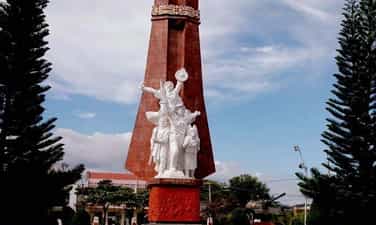
Dak To victory relic - new scenery
The Dak To - Tan Canh victory shook the entire US-Puppet defense system in the Central Highlands, expanding the liberated area and with the Quang Tri victory, the Southeast region created a new situation in the war. Southern school, contributing to defeating the strategy of "Vietnamization of the war", "Nich Son Doctrine" in Indochina, forcing the US to sign the Paris Agreement to withdraw troops from Vietnam. The Central Highlands is an important strategic area of the region. Among them, Kon Tum is the northern tip of the Central Highlands, located at the intersection of the Vietnam - Laos - Cambodia border; connecting the North - South corridor and the corridor between East and West Truong Son. With this important geopolitical position, the US empire and the Saigon puppet government have concentrated all forces to build the North Kon Tum region into the most solid defense area in the Northern Central Highlands, centered on Dak To - Tan Canh defense cluster. From 1957 to 1972, the US-Puppet built in Dak To - Tan Canh the most solid defense system including base E42 in Tan Canh and base Dak To 2. Therefore, Dak To - Tan Canh The scene became the site of many fierce battles between us and the enemy. In particular, many major campaigns were carried out here such as: Dak To 1 Campaign in 1967, the Central Highlands armed forces destroyed part of the 4th Infantry Division, the 1st Airborne Cavalry Division and The US 173rd Airborne Group at height 875 contributed to the General Offensive and Uprising of Mau Than in 1968, Dak To Campaign 2 in 1969, we destroyed many enemy forces, contributing to defeating the local war strategy. Ministry and the US "search and destroy" plan on the Central Highlands battlefield and especially the 1972 Spring-Summer campaign in the Northern Central Highlands, the focus of which was the liberation of Dak To - Tan Canh. Implementing the guiding policy of the Politburo and the Central Military Commission, our units decided to open the Spring - Summer 1972 campaign with the aim of "Destroying the enemy, liberating Dak To - Tan Canh, if conditions permit, liberate Dak To - Tan Canh". release Kon Tum town. The development direction may be in the direction of Plei Ku; if conditions permit, expand the liberated area west of Plei Ku, liberate Buon Ma Thuot town, forming a complete base connected to the base. Southeast region". Kon Tum Party Committee has mobilized maximum local army forces, guerrillas, and civil servants to coordinate with the main force of B3 and Zone 5 to participate in the campaign. On the enemy's side, the total number of enemy forces deployed in this area amounted to 28 infantry battalions, 6 artillery battalions, 4 armored battalions. The enemy was determined to concentrate their forces to form a solid defense line. prevent the liberation army from taking over the Central Highlands. With the concentration of forces and careful preparation, the two sides created a fierce, fierce battle with complete victory in favor of the liberation army. At exactly 11:00 a.m. on April 24, 1972, the liberation flag given by the Kon Tum Provincial Party Committee to the 66th Regiment on the day of the departure ceremony was carried into battle by our soldiers and fluttered atop the center of the enemy base. , announced the liberation. The Dak To - Tan Canh defense group, which the US and Puppet dubbed the "steel belt" in the Northern Central Highlands, was completely destroyed by our troops. The victory of Dak To - Tan Canh along with the victory of Quang Tri and the Southeast region were campaigns that had extremely important strategic significance. They created a new situation on the Southern battlefield, contributing defeated an important strategic step of "Vietnamization of the war" and "Nich Son Doctrine" in Indochina, forcing the US to sign the Paris Agreement and withdraw troops from Vietnam. With the determination "Truong Son transforms - Po Ko rises up, wipes out the enemy, liberates Dak To", "All for the front line, all to defeat the American invaders", the people of all ethnic groups in the region Kon Tum province has mobilized maximum human and material resources for this campaign. The "revolutionary noodle fields", "liberation noodle fields", "the sound of pestles pounding rice" all night long... providing food for the front lines or the image of a mother "Holding a gun in her hand, carrying her baby in front, carrying bullets on their backs" of the Kon Tum People of all ethnic groups will forever become a noble symbol of the will of all for lives, for national independence and the desire for peace. With profound historical significance, in 2017 "Dak To - Tan Canh Victory Site was recognized by the Prime Minister as a special national relic. Source: Propaganda Department of Kon Tum Provincial Party Committee
Quang Ngai
6306 view
Rating : Special national monument
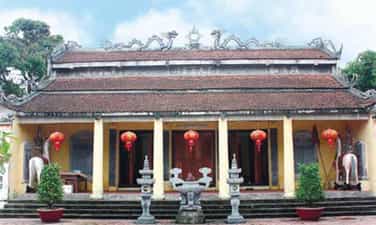
Kim Dang Temple
Kim Dang Temple is located in the center of Kim Dang village, Lam Son ward, Hung Yen town, Hung Yen province today. In the past, this place was Dang Man site, An Tao district, Khoai Chau district, upper Son Nam town. Legend has it that the temple was built on the land Dinh Dien chose as its headquarters with the posture "The Thanh Dragon and the White Tiger are coming". The book "Dai Nam Nhat Thong Chi" records: General Dinh Dien is from Gia Phuong - Gia Vien - Ninh Binh, and is the adopted son of Dinh Cong Tru (father of Dinh Bo Linh). Since childhood, he was Dinh Bo Linh's "reed flag practice" friend. When he grew up, he formed a brotherhood with Nguyen Bac, Lu Co, Trinh Tu and Dinh Bo Linh. When the country was in turmoil among the 12 warlords, a few friends followed warlord Tran Lam to occupy the Bo Hai region (now Tien Hai - Thai Binh). When he became Van Thang Vuong, Dinh Bo Linh assigned Dinh Dien to command 10 armies to conquer other warlords. When he arrived at Dang Man site and saw the beautiful terrain, he immediately built a headquarters and chose three people named Phan, Pham and Nguyen from Dang Man site to be his generals and chose a girl from the Phan family named Moi Nuong to be his wife. . After suppressing the rebellion of 12 warlords, Dinh Bo Linh ascended the throne, proclaimed himself Dinh Tien Hoang, named the country Dai Co Viet, and established the capital in Hoa Lu - Ninh Binh. In the year of Ky Mao (979), Dinh Tien Hoang and his eldest son Dinh Lien were killed by the traitor Do Thich. Dinh Dien and his mandarins proclaimed Dinh Toan (then only 6 years old) to the throne and honored Duong Van. Russia as Queen Mother. When the Song army threatened to invade the northern border, the country faced the threat of foreign invasion, the soldiers proclaimed Thap Dao general Le Hoan to the throne, replacing Dinh Toan who was too young at that time. Not accepting that, Foreign Minister Dinh Dien and Dinh Quoc Cong Nguyen Bac, who was guarding Chau Ai, and Pham Hap raised troops and sent troops from Thanh Hoa to attack Hoa Lu but failed, Dinh Dien withdrew his troops to Dang Man camp. On November 17 (lunar calendar) in the year of Ky Mao (979), Dinh Dien and his wife passed away, the people of Dang Man camp built a temple on the base of the barracks, and 3 generals of Dinh Dien were also worshiped here. Over time, the temple has been restored many times. Currently, Kim Dang Temple still retains many architectural features of the Later Le and Nguyen dynasties. In 1997, the temple was classified as a historical relic by the Ministry of Culture and Information. The temple has a nail-shaped architecture, including 5 pre-worship spaces and 3 back palace spaces. The altar building is made of a 2-story, 8-roofed overlapping style; The blades are embossed with dragon heads; On the roof line, there is an image of two dragons flanking the sun, and two pincers are decorated with "two fish" (two carp); The roof is covered with dragon scale tiles, the neck frill is decorated with 4 words "Dinh Dai Linh Tu" in Chinese characters. The structure of the hitching trusses is simple, supported by a system of solid ironwood columns. Connected to the front altar are 3 back-rooms with tiled roofs. The truss structure is in the style of a husband and a lotus, and on the beams are embossed with stylized patterns of flowers and leaves. The central space houses the statues of General Dinh Dien and his wife Phan Thi Moi Nuong, created in a meditating posture... In addition, the relic also preserves a number of horizontal paintings and couplets praising their merits. God. Every year, the Kim Dang Temple festival is held from the 15th to the 17th of the 11th lunar month to commemorate the death of General Dinh Dien and his wife. During the days of the festival, in addition to the palanquin procession, there are also traditional folk games such as cockfighting, lion dancing, spoken singing, military drum singing, water puppetry... to contribute to building solidarity. build relationships with neighbors, educate the Vietnamese people about patriotic traditions, and remember the source when drinking water. Source: Hung Yen Newspaper
Hung Yen
5252 view
Rating : National monument

Cloud Temple
Cloud Temple is located in Dang Chau village - Lam Son ward - Hung Yen town - Hung Yen province. Cloud Temple worships general Pham Phong At, also known as Pham Bach Ho, a talented general of our country in the early period of the era of independence and self-reliance (early 10th century to early 11th century). According to "Dai Nam Nhat Thong Chi", Pham Bach Ho was born on January 10, the year of Canh Ngo (910), his father was Pham Lenh Cong from the Nam Sach Giang route (now Kim Thanh - Hai Duong). Lenh Cong had a large shop in Dang Chau - Kim Dong - Hung Yen (now Xich Dang - Lam Son - Hung Yen). Legend has it that his mother dreamed of Son Tinh and a White Tiger and got pregnant, so she named him White Tiger. When White Tiger grew up, he had a muscular body, strong like a tiger, smarter than others, and perfect in literature and martial arts. Pham Bach Ho used to be the chief of Dang Chau and was a talented general of Duong Dinh Nghe. In the year of Tan Mao 931, he helped the general to expel Ly Tien, governor of Giao Chau; Defeated Tran Bao sent by Duong Minh Tong to rescue him, then proclaimed himself a military governor. When Kieu Cong Tien, a general of Duong Dinh Nghe, killed the general, took the position and asked for help from the Southern Han army to invade our country. Pham Bach Ho coordinated with Ngo Quyen to bring troops to destroy Kieu Cong Tien and defeat the Southern Han army on the Bach Dang River in the year of Mau Tuat (938). When Ngo Quyen died, Duong Tam Kha usurped the throne, Pham Bach Ho and Do Canh Thac overthrew Duong Tam Kha and Ngo Xuong Van, Ngo Quyen's son, ascended the throne. This period was called Later Ngo Vuong. In 965, the King of Later Ngo died, and the country's heroes rose to fame in each region. Pham Bach Ho occupied Dang Chau and was one of the twelve warlords at that time. In 968, King Van Thang - Dinh Bo Linh was given full military authority by warlord Tran Lam and quelled the "12 Warlords' Rebellion". Pham Bach Ho led his troops to surrender and was appointed as the bodyguard of a Great General. On November 16, the year Nham Than (972), Pham Bach Ho died in his hometown, at the age of 62. Dinh Tien Hoang decreed for the people to build a temple, and all dynasties awarded him the title: "Khai Thien protects the country, the most sacred spirit". Legend has it that the god is very sacred. In the past, King Le Ngo Trieu (also known as Le Long Dinh), when he had not yet ascended the throne, had a hamlet in Dang Chau and often went boating. One day, when it rained heavily, Long Dinh sought shelter and saw a temple on the riverbank. He asked the villagers: "What god is the temple worshiping?" sacred?” said that "this is the support of a continent, the ceremony of praying for rain and stopping is very suitable". Vuong then said loudly: "If God can make wind and rain, then try to make this side of the river stop and the other side of the river rain. That would be truly sacred!" After saying that, it was true that half of the river on the other side was raining very heavily, and half of the river on the other side was very heavy. This is the only cool breeze. Long Dinh did not get wet, so it was surprising that he ordered the temple to be repaired. Over time, the Cloud Temple has been restored and remodeled many times. Today, the temple's architecture still features the carving art of the Later Le and Nguyen dynasties. The temple was built in the Tam style including: front altar, middle temple and back palace. The altar hall with 3 compartments is made in the style of gabled walls and the roof is covered with funny-shaped tiles. The altar is decorated with a system of hammock doors, grand letters, horizontal panels, and parallel sentences. In the middle of the altar hall hangs a grand pagoda inlaid with mother-of-pearl inscribed with words. "Thai Binh Royal Palace". The side rooms hang horizontal paintings. Connected to the altar are 5 central spaces made in parallel but with higher floors. On both sides of the column hang a pair of parallel sentences praising the general's merits. The harem consists of 3 compartments, with a simple structure and no carved patterns. In the temple, there are still 27 statues, most of which were created during the Le Dynasty, two palanquins and a very precious bronze incense burner. Every year, the Cloud Temple festival is held at two different times: January from the 8th to the 16th (lunar calendar) is the birthday celebration festival; From November 12 to 18 (lunar calendar) is the festival commemorating the transformation day of General Pham Bach Ho. In the festival, in addition to the previous ceremony, there was also a festival with many traditional games imbued with the culture of Northern residents such as: wrestling, lion dance, military drum singing, water puppetry, chess playing... In 1992 , the Ministry of Culture and Information has recognized the Cloud Temple as a historical and architectural artistic relic. Source: Hung Yen city electronic information portal
Hung Yen
5030 view
Rating : National monument
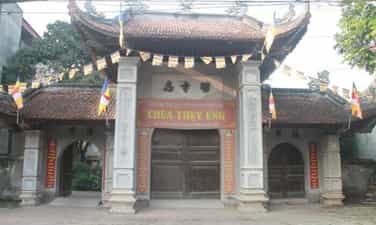
Ne Chau Pagoda
Ne Chau Pagoda's literal name is. "Thuy Ung Tu", associated with the name of Mrs. Nguyen Thi Ngoc Thanh, wife of King Le Dai Hanh. The pagoda is located in Ne Chau village, Hong Nam commune, Tien Lu district, Hung Yen province. Legend has it that Ne Chau Pagoda was built in the Early Le Dynasty (10th century) on a small initial scale. When the Le Hoan insurgent army stationed here to fight against foreign Song invaders, he built a new pagoda on the land of Phuong Cai village (today Ne Chau village), replacing the old ruined pagoda. When the pagoda was completed, Phuong Cai villagers could not afford to pay the workers. Le Hoan taught that "If any village has enough money to pay workers, the pagoda belongs to that village." At that time, the villagers of Ne Chau asked for help from Ms. Nguyen Thi Ngoc Thanh's family, so they were able to pay the workers, and the pagoda belonged to Ne Chau village from then on. Le Hoan loved the beautiful Ngoc Thanh so he married her. During this time, she contributed her efforts, helping the insurgents hide food and provisions, and taking care of logistics. Defeating the enemy, Le Hoan ascended the throne, but she did not follow the king to Hoa Lu but asked to stay in her homeland to take care of her elderly parents. After her death, the king built a temple opposite Ne Chau pagoda and ordained her as "Queen Ngoc Thanh". Through the dynasties, Ne Chau pagoda was embellished, the most recent time was during the Nguyen dynasty, Bao Dai Nguyen year (1926). By 1992, Ne Chau Pagoda was ranked as a national historical and cultural relic. In 2005, within the framework of the project to repair Pho Hien ancient relics phase II, Ne Chau pagoda continued to be restored according to the original. The pagoda was built in the style of "Foreign Internal Cong" with many items, of which 3 prominent items are: Front Hall, Upper Palace and two corridors. The Tien Duong House of Ne Chau Pagoda consists of 7 compartments, designed in a simple truss style. On both sides of the gable there are two tall bronze columns, on the top of the columns are two cows facing each other. Above, in the middle of the roof, there are three Chinese characters "Thuy Ung Tu" embossed. All decorative patterns in the Tien Duong house are carved with images of two dragons flanking the moon and stylized flowers and leaves, imbued with the culture of the Le Dynasty. The Upper Palace's architecture resembles Tien Duong. Inside the Upper Palace, there are beautiful worship statues with high sculptural artistic value, among which the Tam The and Tuyet Son statues stand out. The statue of Tam The is carved from wood, in a meditating position on a lotus flower, with a kindly smiling face. The lotus faces are engraved with images of flowers and some Buddhist stories. Notably, all three Tam The statues lean back on a wooden leaf shaped like a tablet. Unlike the Tam The statue, the Tuyet Son statue is carved in a contemplative sitting position, with both hands clasped on the knees. This is an ancient statue from the Le Dynasty, the embodiment of Shakyamuni Buddha during his cultivation period on Tuyet Son Mountain. The two corridors of Ne Chau Pagoda are located symmetrically, with hundreds of statues with different postures and facial expressions, fully depicting Buddhist stories. Particularly, the temple dedicated to Mrs. Nguyen Thi Ngoc Thanh (located opposite Ne Chau Pagoda) has a Dinh-style architecture including 3 pre-sacrificing rooms and 2 back palace rooms. The temple has a lotus-shaped architectural structure, carved with stylized patterns, bearing the architectural style of the Nguyen Dynasty. Every year, Ne Chau Pagoda often holds sacrifices on the 15th day of the first month and the 15th day of the 8th lunar month to commemorate the birth and death of Ms. Nguyen Thi Ngoc Thanh. Source: Hung Yen city electronic information portal
Hung Yen
4681 view
Rating : National monument

Chuong Pagoda
Chuong Pagoda has the literal name "Kim Chung Tu" located in Nhan Duc village, Hien Nam ward, Hung Yen town. Legend has it that in a year of great flood, a golden bell floated on a raft to the river bank in Nhan Duc village. Different places raced to ring the bell in their locality but could not. Only the elders of Nhan Duc village can ring the bell. The villagers thought that God was helping them, so they contributed to building the pagoda and building a bell tower. Every time the bell rings, the sound echoes thousands of miles away. Therefore, the pagoda is also called Kim Chung Tu (golden bell pagoda). Chuong Pagoda was built in the Le Dynasty (15th century) and underwent many restorations and embellishments later, but still retains the artistic architectural features of the Later Le Dynasty (17th century). In "Hung Yen province Nhat Thong Chi" by Trinh Nhu Tau, it is written "Chuong Pagoda - famous Hien street". In 1992, Chuong Pagoda was ranked as a national historical, cultural, architectural and artistic relic. The architectural complex of Chuong Pagoda has a harmonious layout, in the style of "Foreign Noi Cong", including items: Three gates, Front hall, Upper palace, To house, Mother house, bell tower and 2 corridors. .. The front of the pagoda faces South, which is the direction of "Prajna" and "Wisdom". The buildings of Chuong Pagoda are located symmetrically on the axis connecting Tam Quan to the Patriarch's house. The Tam Quan gate is built in the style of a two-story, eight-roofed stack of matches, with decorative motifs and patterns such as an embossed dragon image, a bas-relief of Tang Monk and his disciples going to get sutras at Tay Truc... Through the Tam Quan gate, you will reach the green stone bridge built in 1702, spanning the dragon eye pond. Next is the unique path paved with green stones leading straight to the Front Street, which according to Buddhist concept is the true path leading people out of the ocean of suffering. The front hall has a scale of 5 rooms and 2 wings, the architecture is in the style of husband and wife fighting lotus. Next is a small yard, in the middle of the yard there is a stone incense tree also known as "Thach pillar", on four sides there are Chinese characters engraved to record the merit of the people contributing to the repair of Chuong Pagoda. The Upper Palace also consists of 5 compartments and 2 wings, with the same structure as Tien Duong. Inside are decorated with many elaborately crafted statues such as: statues of Tam The, Bodhisattvas, Manjushri, Pho Hien, Jade Emperor, Nam Tao, Bac Dau, Shakyamuni Buddha, Amitabha Buddha... Through the Upper Palace, there are two symmetrical corridors with many statues arranged in order. The first is a group of statues sketching the "Ten Palaces of Hell" cave depicting the scenes of torture that people must experience in the underworld according to the Buddhist philosophy of cause and effect. Next is the Vajra Buddha statue, followed by the "Ten Eight Arhats" with 18 statues created with very expressive expressions on each face. At the end of the corridor is the statue of Monsignor, standing next to Gia Lan - Chan Te and the statue of Thanh Hien, standing next to Diem Nhien - Dai Sy. In Chuong Pagoda, there are still many valuable artifacts such as horizontal panels, parallel sentences... especially the stone stele "Kim Chung Tu Stone Biography" built in the 7th year of Vinh Thinh (1711). The stele lists names of meritorious people and describes Pho Hien in its heyday. On January 15, April 8, April 15, and July 15 of the lunar calendar every year, the Bell Pagoda Festival is held, attracting people in the region and tourists from all over. Source: Hung Yen city electronic information portal
Hung Yen
4428 view
Rating : National monument