Relic point Vietnam
Việt Nam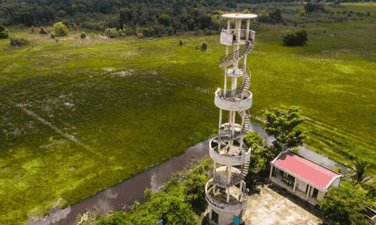
Lo Go - Xa Mat National Park
Lo Go - Xa Mat National Park is located at 235 National Highway 22B, located in Tan Binh commune, Tan Bien district, Tay Ninh province. Lo Go - Xa Mat National Park in the North and West borders the Vietnam - Cambodia border; The name of Lo Go Xa Mat National Park is combined from two different locations in Tay Ninh province: Lo Go, Xom Moi (now in Hoa Hiep commune, Tan Bien district) and Xa Mat border gate - one of four gateways. The province's most important place in terms of trade exchanges and exploiting foreign economic potential. According to data updated on December 22, 2023, the total area of Lo Go Xa Mat National Park is 30,022 hectares. The garden is divided into 3 main subdivisions with their own functions: 1. Strictly protected zone (area 10,615.16 hectares): A place that focuses on preserving the inherent ecological characteristics of the forest and its flora and fauna. With an ideal coordinate system and influence With a tropical monsoon climate, the tourist area of Lo Go Xa Mat National Park has become the habitat and migration of many rare and endangered animal species according to the Vietnam and world red books. Besides rare animal species, Lo Go - Xa Mat National Park also owns a large forest with nearly 1,000 species of plants, many of which have not yet been discovered and researched. The management board specifically prohibits acts of exploiting resources and building massive infrastructure in this area. 2. Ecological restoration subdivision (area of 30,023 hectares): In this area, people have carried out zoning, afforestation, and reconstruction of natural forest areas that have been destroyed, strengthening the protection of water sources and the environment. surrounding school. 3. Administrative service subdivision (area of 130.46 hectares): Is where management buildings, motels, amusement parks, tourist routes... serve visitors to rest and relax. expansion, while combining protection of nature, avoiding negative impacts on biodiversity. 2019 Recognized as an ASEAN Heritage Garden Coming to Lo Go - Xa Mat National Park, visitors can not only immerse themselves in the majestic natural landscape but also admire many long-standing historical and cultural relics here! 1. The observatory is 32m high 2. Vam Co Dong upstream - natural boundary with Cambodia 3. Landmark 132 is originally a double landmark, in which Landmark 132 (1) is under the management of Cambodia and Landmark 132 (2) is guarded by Vietnamese border guards. 4. Ta Not Trang 5. 215-year-old heritage tree - 44 meters high 6. 269-year-old Otter heritage tree - 42 meters high 7. Stele commemorating the Central Propaganda Department of the Southern Department. The Central Propaganda Department of the Southern Department - the "spearhead" at the forefront of political ideology and mass propaganda, contributed to the great victory in the spring of 1975. 8. Memorial stele of Nguyen Van Troi school. In 1965 - one year after the death of heroic martyr Nguyen Van Troi, the Central Base of the Southern Department established a school named after him, welcoming children of officers and soldiers in the Southeast region to live. , study. The school existed until 1976 and produced many talented people who held important positions in the central and local government apparatus. Source: Vietnam National Tourism Administration
Tay Ninh
4919 view
Rating : National monument
Giac Ngan Pagoda
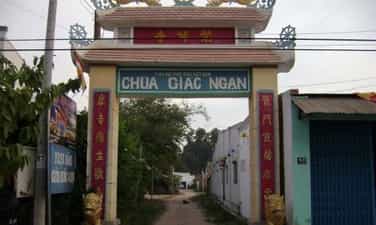
Giac Ngan Pagoda is located on provincial road 781, from Tay Ninh town to Chau Thanh district, one of the ancient pagodas in Tay Ninh that still exists. The pagoda is located in Binh Phong hamlet, Thai Binh commune in a peaceful and pristine setting, with an ancient architecture, close to folk culture, reflecting the traditional beauty of Vietnamese Buddhism. The temple was built on an area of about 400 square meters and is located on a 1 hectare plot of land. The front of the pagoda is a facade consisting of 3 compartments 8m high, with stairs leading up to it on both sides. In front of the yard is a beautiful and simple stone mountain, inside the mountain there is a statue of Bodhisattva Avalokiteśvara. There is also a solemn white statue of Sakyamuni Buddha. To the right of the pagoda is the cemetery, the resting place of deceased Buddhists. Giac Ngan Pagoda was built by Luc Hoa Tang Buddhist sect more than 100 years ago, after Thien Lam Pagoda, at the same time as Phuoc Lam, Cao Son, Long Son, Hanh Lam, Cam Phong pagodas. At first, the pagoda was only built with simple materials. It was not until 1950 that it was built solidly according to today's architecture. The person who repaired and rebuilt the pagoda was monk Thich Giac Thien from Ba Den mountain. Next is monk Thich Tinh Hai. Since 1994, Venerable Thich Hue Thong has been the abbot until now. During the resistance war against the French and Americans, Giac Ngan Pagoda was once a safe base for revolutionary cadres. Nowadays, sometimes people still come back to visit the beloved temple of the past. During spring days and major Buddhist holidays such as the full moon days of January, April, and July, Giac Ngan Pagoda is always bustling and crowded. Believers and Buddhists who come here are not only local people but also many people from other places. Source: Tay Ninh Buddhism
Tay Ninh
8577 view
Rating : Provincial level relics

Junction City Victory Monument
Junction City victory memorial site (Tan Chau, Tay Ninh) is one of the fierce points where the US Empire bombed, with the illusion of achieving military victory to resolve the war in the South of the country. ta. During the years 1965 - 1968, the US and the Saigon government mobilized tens of thousands of troops to consecutively organize two strategic counter-attacks in the dry season of 1965-1966; 1966-1967, in order to "find and destroy" the main force of the Liberation Army and complete the "pacification" of the South. But contrary to the calculations of the American Empire, their "search and destroy" and "pacification" operations failed one after another. In particular, after the failure in the "search and destroy" operations against Attleboro (October 12, 1966 - November 25, 1966) and Cedarfalls (January 8, 1967 - January 26, 1967), the US government was even more divided. deepen. Trying to overcome this situation, from February 22 to April 15, 1967, the US Empire mobilized 45,000 troops, with 1,200 tanks, armored vehicles, 256 artillery pieces of all kinds and 160 combat aircraft and other weapons. weapons, strong firepower, launched the Junction City operation with the hope of implementing the two-pronged strategy of "search and destroy and pacify" to attack the Bac Tay Ninh base to destroy the Central Bureau of the South, Division 9 The main forces of the Liberation Army and the Liberation Radio station sealed the Cambodian border and destroyed the revolutionary forces' logistical reserves. Meanwhile, our forces only have the 9th Regional Main Force Division, reinforced by the 16th Regiment and other forces with the motto of sticking to fighting on the spot, building a people's war network in the base area, ready to attack the enemy at bases, destroy warehouses, and strongly attack "strategic hamlets" to contribute to breaking the strategic counterattack of the American Empire. After 53 days and nights, our army and people eliminated 14,233 American troops from combat, shot down and destroyed 160 aircraft, 992 military vehicles (including 775 tanks and armored vehicles), 112 artillery pieces of all kinds, destroying 3 battalions and 11 infantry companies, 3 battalions and 5 artillery companies, 10 US armored divisions. Among them, local guerrillas and soldiers destroyed 6,619 enemies, 434 vehicles (including 425 tanks and armored vehicles), 110 aircraft and 3 artillery pieces. The Bac Tay Ninh base area is maintained. The victory in the counterattack campaign to defeat the Junction City operation - the pinnacle of the US military's "search and destroy" strategic measure - is one of the strategically significant victories in the resistance war against the US to save the country. our army and people. By breaking this operation, we have preserved the headquarters commanding the resistance, maintained the Central base of the Southern Department, the Regional Command, the National Liberation Front, and preserved the forces. Revolution. At the same time, it dealt a decisive blow to America's efforts in escalating the war in the South, causing the failure of the second strategic counterattack, contributing to the collapse of the "Local War" strategy. . With historical and military values, Junction City Victory Memorial Site was ranked as a national historical site by the Ministry of Culture, Sports and Tourism on November 12, 2013. Source: World Heritage
Tay Ninh
5393 view
Rating : National monument
Central Base of the Southern Department
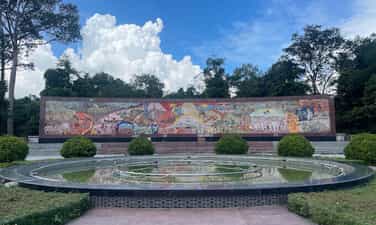
The historical site of the Central Base of the Southern Department is located in Chang Riec forest, Rum Duon, Tan Lap commune, Tan Bien district, Tay Ninh province. The Southern Department Central Base is in the north of Tay Ninh province, close to the Vietnam - Cambodia border. The relic area is also known by other names, such as: R (code name of the Central Department of the South); Chang Riec Base (named after the forest where the Base is located); Pham Hung Base (comrade Pham Hung once held the position of Secretary of the Central Bureau for a long time); Bac Tay Ninh base. During the two resistance wars against the French and the Americans, the Southeast region in general and Tay Ninh in particular were important strategic areas. The Northern Tay Ninh base area was the area of the Southern revolutionary headquarters for a long time and directly directed and led the Southern revolution until the day the South was completely liberated. The historical site of the Central Base of the Southern Department includes three subdivisions: Central Base of the Southern Department, Base of the National Liberation Front of South Vietnam and Base of the Provisional Revolutionary Government of the Southern Republic. Vietnam. 1. Central Base of the Southern Department In March 1951, the first Central Conference (term II) decided to establish the Central Committee for the South, with comrade Le Duan as Secretary and comrade Le Duc Tho as Deputy Secretary. After that, comrade Le Duc Tho was appointed as Secretary, comrade Pham Hung as Deputy Secretary. On September 6, 1954, the Politburo decided to dissolve the Central Committee of the South and re-establish the Southern Regional Party Committee and the Regional Party Committees. On January 23, 1961, the 3rd Conference of the Party Central Committee (term III) decided to re-establish the Central Bureau of the South. In early 1965, the Central Department was assigned the task of directing the South and the South Central Department. Comrade Nguyen Van Linh, Secretary of the Southern Party Committee, assumed the responsibility of Secretary of the Central Department. During the period 1967 - 1975, comrade Pham Hung was Secretary; Comrades Nguyen Van Linh, Phan Van Dang and Hoang Van Thai as Deputy Secretaries of the Central Bureau. 2. Base of the National Front for the Liberation of South Vietnam On December 20, 1960, in Trang Chieng, Tan Lap commune, Chau Thanh district (now Tan Bien district, Tay Ninh province), the National Front for the Liberation of South Vietnam was established and appointed to the Central Committee. temporary. 3. Base of the Provisional Revolutionary Government of the Republic of South Vietnam From June 6 - 8, 1969, in Ta Not forest, Chau Thanh district (now Tan Bien district, Tay Ninh province), the Provisional Revolutionary Government of the Republic of South Vietnam was established. Architect Huynh Tan Phat is Chairman of the Provisional Revolutionary Government of the Republic of South Vietnam, Lawyer Nguyen Huu Tho is Chairman of the Advisory Council. The historical site of the Central Base of the Southern Department has special value. During 15 years (1961 - 1975), the Central Committee concretized many policies and guidelines of the Party and President Ho Chi Minh into the reality of the Southern revolution, thereby giving birth to many Directives and Resolutions. , decided the strategic direction of the Southern revolution and successfully deployed it throughout the entire Southern battlefield. With the special values of the monument, on May 10, 2012, the Prime Minister decided to classify the Southern Department Central Base Historical Relic as a special national monument. Source: Department of Cultural Heritage
Tay Ninh
5343 view
Rating : Special national monument
Boi Loi historical site
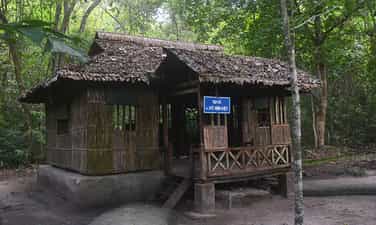
Tay Ninh Provincial Party Committee base at Boi Loi, Trang Sa hamlet, Don Thuan commune, Trang Bang district, Tay Ninh province. During the two resistance wars against the French and the Americans, this place was the base of the Executive Committee of Tay Ninh Provincial Party Committee; of the Eastern Inter-Region, a part of the Southern Regional Party Committee during the anti-French period and a part of the Central Committee during the anti-American period. The Saigon - Gia Dinh City Party Committee and a number of agencies of the Saigon - Gia Dinh City Party Committee were also based here. Boi Loi was also the base of Trang Bang and Go Dau District Party Committee during the resistance period. Although he moved to many places, Boi Loi was the place where the Tay Ninh Provincial Party Committee had the longest stay. It was here that from 1946 to 1975, many particularly important historical events took place. Many Regional and Provincial Party Committee conferences were held here and issued important resolutions, leading the revolutionary movement of the masses through the stages. For 15 years (1960-1975), the US and puppet groups conducted hundreds of raids, sprayed toxic chemicals, and used B52 flying fortresses to carpet the Boi Loi forest in an attempt to encircle and destroy the revolution there. Due to its extremely special strategic location, Boi Loi belongs to the iron triangle at the Northwest gateway of Saigon (Trang Bang - Cu Chi - Ben Cat), so the enemy's bomb intensity was extremely devastating. However, the Provincial Party Committee and agencies of the Tay Ninh Provincial Party Committee still remained firmly in place, steadfastly leading and directing the revolutionary movement in Tay Ninh to the day of complete victory. With the above historical value, the Tay Ninh Provincial Party Committee base relic at Boi Loi was recognized as a national historical-cultural relic on January 26, 1999. Source: Tay Ninh province electronic information portal
Tay Ninh
5393 view
Rating : National monument
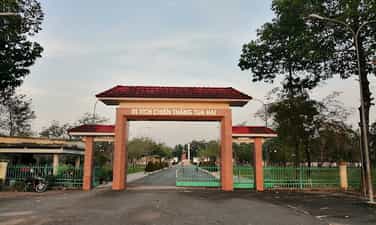
Tua Hai Victory Monument
The relic is located in Tua Hai hamlet, Dong Khoi commune, Chau Thanh district, Tay Ninh province. Here, on the night of January 25 and 26, 1960, implementing Resolution 15 Central under the direction of the Southern Party Committee, the revolutionary armed forces along with the people of Tay Ninh conducted a raid to destroy the base. Regiment 32, Division 21 puppet at Tua Hai - The opening battle of the armed uprising movement throughout the South has gone down in history and become a revolutionary historical relic. The Tua Hai victory, which opened the armed movement, went down in history and became a milestone marking the transition of the southern revolution, opening up a method of political struggle combined with armed forces, creating a world war. "two legs, three tips, three areas" comb. After the Tua Hai victory, the co-insurgency movement spread throughout the southern provinces, proving that the 15th Party Central Committee resolution was issued at the right time and opportunity. The Tua Hai battle was the result of long-term preparation, the accumulation of hatred and sacrifices caused by the national policy of "Destroying communism and the fascist law of October 1959 of America-Diem that caused the compatriots." The battle of Tua Hai shattered the morale of the enemy soldiers. They believed that the soldiers attacking Tua Hai were the "main force of North Vietnam". If they defeated Tua Hai, the Viet Cong would have no difficulty. get the Town and the entire province. After the battle of Tua Hai, the popular uprising and the revolutionary people's armed forces were born with highly effective battles, destroying many enemies. The battle of Tua Hai on the night of January 25 and 26, 1960 in Tay Ninh was a major battle, killing over 500 enemies, capturing 1,500 guns of all kinds, promoting the victory of Tua Hai, the people of Tay Ninh rose up simultaneously to liberate two parts. three communes in the province. With that historical value. The Tua Hai victory site was recognized by the Ministry of Culture and Information as a cultural and historical relic on July 23, 1993. Source: Tay Ninh Newspaper
Tay Ninh
4999 view
Rating : National monument

Temple of Lady Han
Nang Han Temple is located in Tay An village, Muong So commune and Phai Cat village, Khong Lao commune, Phong Tho district, Lai Chau province. This is a place to worship the legendary character known by the people as Miss Han (She means daughter, Han means hero). Legend has it that Nang Han came from a poor Thai family in Chieng Sa (now Muong So commune, Phong Tho district, Lai Chau province). She disguised herself as a man and stood up to call on the young men of the villages to unite and fight the enemy. She led the uprising of 16 Thai people who stubbornly defeated the Northern invaders. After leading the victorious army back, she bathed in the water of Tay An (Muong So commune) and then flew to the sky. From then on, remembering her gratitude, people built a temple and held a festival right in the water where she bathed. Ms. Han is not only a worshiped figure of people in Muong So commune or Lai Chau province in particular, but Ms. Han is a worshiped figure of all White Thai ethnic people throughout the Northwest region. Miss Han in the spirituality of 16 Thai and Muong regions in the Northwest is like Ba Trung and Ba Trieu to the Kinh people. On December 25, 2007, the People's Committee of Lai Chau province recognized Nang Han Temple as a provincial-level historical, cultural, architectural and artistic relic. Source: Lai Chau province electronic information portal
Lai Chau
7543 view
Rating : Provincial level relics

Muong Bum Fort
Muong Bum Fort was designed by the French colonialists based on the rugged terrain, built solidly in 1917 and had a long-term strategy with a large area located on the top of the hill in Bum village, Bum Nua commune (now part of the town). Muong Te). With a total area of 2,592m2, length of 72m, width of 36m, divided into three levels along the length, surrounded by solid walls, four important observation corners are built with four defensive bunkers. . The defense system is divided into three main firepower clusters, including the battlements, the fort system is surrounded by solid walls, the front has the main gate, the back has a side gate, the side is adjacent to the Nam Xi Luong stream still has a gate used for retreat when attacked and to supply food and reinforcements by waterway. When there is an alarm, all gates are closed, the station system is completely closed and is put into a state of combat readiness. Muong Bum Fort is not only a military operation, but within the station is an entire system, an overall architecture including a defense system, base, and production increase that is calculated and has a long-term strategy. Many important local historical events took place here such as the war against the Fascists (remains of the French colonialists and reactionary henchmen (December 1953 - 1954)... Muong Bum Fort was ranked as a provincial historical relic by the People's Committee of Lai Chau province on April 25, 2011. Source: Lai Chau province electronic information portal
Lai Chau
5461 view
Rating : Provincial level relics

Relics where lawyer - president Nguyen Huu Tho was imprisoned
Relics where lawyer - president Nguyen Huu Tho were imprisoned. Recognized as a provincial-level historical and cultural relic on August 23, 2012. The relic is located in Ban Giang area - Muong Te commune - Muong Te district, Lai Chau province. Previously, the French colonialists detained the late lawyer Nguyen Huu Tho. Local people built a wooden stilt house for Nguyen Huu Tho to live in. In June 1950, the French colonialists sent a plane to transport Lawyer to Son La town from Son La, and cars transported Lawyer along route 6. to Lai Chau. Lawyer Nguyen Huu Tho was born on July 10, 1910. In 1930 he studied Law in France and returned to the country in 1933. In 1948 he joined the pan-Vietnamese front, and in 1949 was admitted to the Indochina Communist Party. He was active in the patriotic intellectual movement, was arrested by the French colonialists in June 1950 and imprisoned in Lai Chau (in Giang village, Muong Te Commune, Muong Te District, Lai Chau Province today), after which he was imprisoned. Rotated to Son Tay until November 1952. At the end of November 1961, Lawyer Nguyen Huu Tho returned to Tay Ninh. In February 1962, the first Congress of the National Front for the Liberation of South Vietnam was held and he was elected Chairman. In June 1969, the provisional revolutionary government of the Republic of South Vietnam was established, and he held the position of chairman of the advisory council. In 1976, he was elected Vice President of a unified Vietnam. In April 1980, after President Ton Duc Thang passed away, he served as Acting President until July 1981. From 1981 to 1987, he was Chairman of the National Assembly of Vietnam. He was awarded the "Golden Star Medal" in 1993. He died in Ho Chi Minh City on December 24, 1996. Through this, we can see that lawyer - Chairman Nguyen Huu Tho has the life and career of a talented patriotic intellectual, a noble moral example and lifelong contributions to the country and the people. He is a representative of national solidarity, a talented leader, and a shining example of revolutionary ethics. On December 8, 2012, the People's Committee of Lai Chau province also cut the ribbon to inaugurate the Memorial House (where some pictures of Lawyer Nguyen Huu Tho are kept) - of the Primary School named after Nguyen Huu Tho in Muong Te commune - District. Muong Te. Source: Lai Chau Tourism
Lai Chau
5491 view
Rating : Provincial level relics
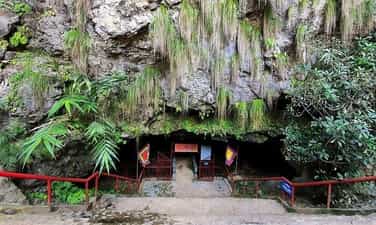
Tien Son Cave
Tien Son cave (other names are Dan Don cave, Po Ngai Tung cave, Da Trang cave, Binh Lu cave) is located next to Highway 4D, in Binh Lu commune, Tam Duong district. Tien Son Cave with caves located in a scenic complex associated with the legend of 99 mountains and 99 lakes of Lai Chau ethnic people - has become a unique beauty that few places have. The legend of Tien Son cave has been passed down through many generations: the 99 mountains are the symbol of 99 healthy, strong boys, while the 99 clear blue lakes are the symbol of 99 hardworking, beautiful girls. Pretty. The mountains and lakes follow each other to create a wall that holds a rich and fertile land. The beautiful scenery and people here became the inspiration for the wonderful lyrics "ninety-nine mountains for boys, ninety-nine blue lakes for girls"... Tien Son Cave has 49 consecutive arcs running through two mountain slopes. The deeper you go inside, the larger the area of the arcs becomes. In the cave there are many stalactites of various shapes and magical colors. At the bottom of the cave, there is a clear stream flowing through, winding through palaces such as: Palace of Merit, Lac Long Quan, Mau Au Co, Ba Chua Kho, clearing injustice, asking for children. Tien Son is a famous natural cave in the region that still retains its wild beauty. During the resistance war against the French colonialists, this place was also a place to hide food and the base of the revolutionary movement. In 1996, the Ministry of Culture and Information recognized Tien Son cave as a national historical and cultural relic and scenic spot. Source: Lai Chau province electronic information portal
Lai Chau
7712 view
Rating : National monument