Relic point Vietnam
Việt Nam
Ninh Hoa Duong Palace
According to Dai Nam Nhat Thong Chi, from the reign of King Gia Long to the first year of Minh Menh (1820), Ninh Hoa Palace was the district administrative headquarters; In the 12th year of Minh Menh's reign (1831), this headquarters was rebuilt on a spacious scale, suitable for being the district administrative headquarters (then the Palace). Currently, Ninh Hoa Street Palace is located on the campus of the People's Committee of Ninh Hoa district, Ninh Hiep ward, Ninh Hoa town, Khanh Hoa province. Ninh Hoa Street Palace is a rectangular architectural work with four sides being gable walls, the facade facing Southeast. Overall, the monument is structured according to the traditional house motif of the Khanh Hoa delta in the style of 3 rooms and 2 wings. Particularly, the front wall of the porch and the roof are decorated according to the motif of the ancient citadel structure in the ancient capital of Hue - traditional architecture of the Nguyen Dynasty. This gives the monument both its ancient features and the solemnity of a public square; Harmonious architectural structure, high artistic value. In 1930, at the same time as the establishment of the Khanh Hoa Provincial Party Committee, the Tan Dinh District Party Committee was also established. Implementing the decision of the Southern Party Committee, on the basis of highly appreciating the revolutionary movement of Tan Dinh district, the Khanh Hoa Provisional Provincial Party Committee instructed the Tan Dinh Party Committee to mobilize the masses to protest and fight in response to the movement. in Nghe An. At around 5 a.m. on July 16, the protest group entered Highway 1 at the intersection of Highway 1 to the current Town Hospital. Many people responded very enthusiastically. They joined the protest group and shouted slogans. The protest group became more and more crowded, up to thousands of people, and the momentum became stronger and stronger. The protest group entered the district, Dinh Ba Can and the district magistrate were so scared that they did not dare to take any action against them. Having won, the protest group spread out to march through the streets and then gathered in front of Dinh market for a rally. People in the neighborhood and compatriots who were buying and selling in the market came in large numbers. Comrade Duong Chuoc stood up to clearly point out the plots and crimes of the colonialists and feudalists, and at the same time briefly stated the policies and guidelines of the Communist Party of Vietnam, calling on compatriots to unite and stand up to fight against oppression. oppression and exploitation. The victory of the protest on July 16, 1930 was a brilliant mark that opened the brilliant period of revolutionary struggle of the Party Committee and people of Ninh Hoa district. To mark this important event, the Provincial Party Committee and People's Council of Khanh Hoa province issued a Resolution, taking July 16 every year as "Traditional Day of Revolutionary Struggle of the Party Committee and People of Khanh Hoa Province". In 1931, Tan Dinh district and 3 cantons of Quang Phuoc district were merged into Phu Ninh Hoa, Tan Dinh district became Ninh Hoa Phu Duong. In August 1945, the uprising in Van Ninh broke out and won, opening the revolutionary spirit in Khanh Hoa. The revolutionary movement to seize power in Ninh Hoa Palace rose, the people of Ninh Hoa rose up in rebellion to seize power in most rural areas. After winning the August Revolution in 1945, the Provisional Revolutionary Committee of Ninh Hoa Palace was stationed at Ninh Hoa Palace. On September 2, 1945, revolutionary cadres and local people gathered at Phu Duong Palace to listen via radio to the Declaration of Independence giving birth to the Democratic Republic of Vietnam read by President Ho Chi Minh at the Palace. Ba Dinh Square (Hanoi). Ninh Hoa Street Palace is also where the Provisional Revolutionary Committee of Ninh Hoa Palace organized and launched patriotic movements such as Golden Week, Independence Fund, Resistance Rice Jar, Army Rice Jar... in the early days. gain independence. In addition, Ninh Hoa Palace is also the place where other events take place such as: Place of establishment and stationing of the Nha Trang and Central Highlands Front Command; where people gathered to listen to comrade Le Van Hien read Uncle Ho's letter to the compatriots and soldiers of Khanh Hoa; where the general election to elect the National Assembly of Vietnam is held; where comrade Vo Nguyen Giap came to work and live while checking the combat situation of the army and people of Khanh Hoa... With the historical-cultural values of Ninh Hoa Palace, the Ministry of Culture, Sports and Tourism ranked Ninh Hoa Palace as a National Historical-Cultural Monument on August 21, 2000. Source: Khanh Hoa Province Monuments Conservation Center
Khanh Hoa
5438 view
Rating : National monument

Lang Ba Vu
Ba Vu Mausoleum (also known as Nhu Mau Mausoleum) is located in group 9, Ninh Hiep ward, Ninh Hoa town, Khanh Hoa province. Mausoleum of Ba Vu is the burial place of the woman who helped Lord Nguyen Phuc Anh (later King Gia Long) overcome the hardship during the war with the Tay Son Dynasty. The project was directed by the king to be built according to the mausoleum architecture to repay gratitude, so the people call it a mausoleum. Going back in history, from 1775 onwards, Khanh Hoa was a land where disputes frequently occurred between the Tay Son army and the Nguyen Lord army. The book "Dai Nam Thuc Luc" of the National History Office of the Nguyen Dynasty records: Nguyen Anh led troops 5 times to attack Binh Khang district (present-day Khanh Hoa) and in all of those times, Nguyen Anh was defeated by the Tay Son army. scattered and chased everywhere, typically in the naval battle in the Hon Thi area (1784). When fighting with the Tay Son dynasty, Nguyen Anh failed many times and had to pull the remnants of his army to flee. One time when running to My Hiep village, the food was exhausted, he was sick, the soldiers were both hungry and exhausted. …the situation is extremely dangerous. In the dark of night, Nguyen Anh and his entourage knocked on a resident's door to ask for a bowl of rice to ease his stomach. The homeowner (legend is Mrs. Truong Thi Tiem) felt compassion and invited Nguyen Anh and his entourage to the house to rest. After that, she sent her maids to kill the pigs, cook rice for everyone, and provide extra food for the journey. As for Nguyen Anh, in addition to taking good care of his medicine, she also had someone milk the cow for him to drink to quickly restore his health. Thanks to that dedicated care and kind treatment, Nguyen Anh soon recovered, and the generals gradually recovered their health to continue pulling troops to the South. After Nguyen Anh unified the country, ascended the throne and took the title Gia Long (1802-1819). Remembering the help of people in the past, the king sent someone to My Hiep village to bring the old lady to the capital to take care of her. However, when the messenger arrived, the old woman had passed away. To show his gratitude, King Gia Long posthumously awarded her the title "Nhu Mau" (nanny). At the same time, the king ordered the Ministry of Public Works to send a number of skilled workers who were building the king's palace in the capital at that time to My Hiep to coordinate with local workers to build a mausoleum for the Nanny according to the mausoleum specifications of the King. Royal. The mausoleum was built in two years, from 1802 to 1804 and completed. The inauguration ceremony was held in a grand manner and was directly presided over by the provincial governor. Besides, because she had no descendants to burn incense and worship, the king also granted land to people in the area to cultivate without having to pay taxes to pay for her death anniversary (oral tradition is December 16). Every year, on the anniversary of her death, dignitaries and villagers gather to hold a very solemn death anniversary ceremony, complete with music and rituals like royal mausoleums. Since then, the incense burning and offerings at Ba Vu's mausoleum are still conducted by the Tuan Vu Khanh Hoa mandarin following the two-period Spring and Autumn custom. Today, the Relics Management Board along with the local government and people still organize the death anniversary of Ba Vu on December 16 every year. Lang Ba Vu is a cultural heritage ranked by the Ministry of Culture and Information (now the Ministry of Culture, Sports and Tourism) as a National Historical - Cultural Monument on February 12, 1999. The relic not only has moral significance "When you drink water, remember its source" but also has great architectural and artistic value, reflecting the talent of artisans under the Nguyen Dynasty more than two centuries ago. Source: Khanh Hoa Province Monuments Conservation Center
Khanh Hoa
8517 view
Rating : National monument

Temple of Binh Tay Great General
Trinh Phong Temple is located in hamlet 1, Phu An Nam 4 village, Dien An commune, Dien Khanh district, Khanh Hoa province. The temple was built in 1886. Trinh Phong was born in Phu Vinh village, Xuong Ha district, Vinh Xuong district (now Phu Vinh village, Vinh Thanh commune, Nha Trang city). When he was young, he was smart and studied well. In 1864, he passed the Bachelor of Martial Arts exam and was promoted to Admiral by the Nguyen court, taking office in Quang Nam. In 1858, the French colonialists opened fire at Da Nang estuary and then launched a war of aggression throughout our country. Not long after that, they captured the Six Provinces of Cochinchina and had the ambition to take over the land under the management of the Nguyen Dynasty. As the French colonialists' ambition to invade was increasingly revealed, meanwhile, the Nguyen court was divided into two factions: the warring faction and the peaceful faction; He resigned, returned to his homeland, steeled his will, and waited for the opportunity to expel the invaders. According to the 1884 Treaty, Khanh Hoa was a province within the management area of the Nguyen Dynasty (in Central Vietnam). In 1885, King Ham Nghi ascended the throne, a young king with a passionate patriotism, supported by Ton That Thuyet - a general leading the militant faction at the court. In 1885, a counterattack in the Hue Citadel led by Ton That Thuyet opened fire before the French could attack. The counter-attack failed, Ton That Thuyet took King Ham Nghi to Quang Tri, prepared for a long-term resistance and issued the Can Vuong Edict calling on people across the country to stand up and help the king save the country. The Can Vuong Edict served as a unifying command for the patriotic movement in the localities. Across the country, people rose up to resist in many places, and the movement grew stronger and stronger. In Khanh Hoa, Trinh Phong and other prestigious personalities founded it. “Binh Tay saves the nation” with the slogan: “Little bandits eliminate criminals and pacify the nation; "Hung soldiers respond to the cause to serve the country", calling on people to join the insurgent army, contribute food, train soldiers, and forge weapons ready to fight against the invading French colonialists. Due to his superior intelligence and virtue, Trinh Phong was honored by the insurgent army and people as Binh Tay general, leading the insurgent army. The "Can Vuong" movement in Khanh Hoa led by Trinh Phong has been actively supported by people from all walks of life, especially in terms of food and mobilizing young people to join the insurgency. Although the Can Vuong movement in Khanh Hoa was extinguished, its heroic and indomitable fighting spirit left a particularly deep affection in the hearts of the people of Khanh Hoa. The people honored the three leaders of the movement. Can Vuong movement in Khanh Hoa were Trinh Phong, Tran Duong, Nguyen Khanh with the title "Three masterpieces of Khanh Hoa". Trinh Phong Temple was bestowed the title "Dai Duc Khoi Tinh" by the 13th King Thanh Thai (1901), then in the reign of the 9th King Khai Dinh (1924) he continued to bestow the title with the beautiful title: Duc Bao Trung. Hung Linh Pho Thuan Chinh. Recognizing the historical and cultural values of the relic, in 1991 the Ministry of Culture and Information issued a decision to classify the Trinh Phong Temple relic as a National relic, on August 30, 1991. Source: Department of Culture and Sports of Khanh Hoa province
Khanh Hoa
4591 view
Rating : National monument

Souvenir location for the C235 ship event
Monument of the C235 Ship Event Memorial Site (Ho Chi Minh Sea Road) in Ninh Van commune, Ninh Hoa town. During our people's great resistance war against America to save the country, to provide weapons and equipment for the southern revolution, along with the Ho Chi Minh Trail on land; In July 1959, according to the Politburo's Directive, the Central Military Commission decided to establish Group 759 to organize a sea transport route named "Ho Chi Minh Road at Sea". This is one of the extremely important and strategically significant tasks in the struggle to liberate the South. Especially preparing for the general offensive and uprising of the 1968 Tet Offensive, Navy Command Directed Group 125 to have ship C235 ready for duty. Ship C235 includes 21 officers and soldiers led by Lieutenant Nguyen Phan Vinh as Captain and Lieutenant Nguyen Tuong as Political Commissar. Ship C235 had 2 trips: The first trip departed at 6:30 p.m. on February 6, 1968, carrying 16 tons of weapons leaving the port at base A2 to Hon Heo wharf (Dam Van village - now Tay village, Ninh commune). Van, Ninh Hoa town). On February 10, while still 38 nautical miles from shore, the ship was followed by enemy warships and aircraft. At 12 o'clock on February 11, the Command Headquarters ordered the ship to return to port A3. In A3, the ship is camouflaged and ready to continue its mission. The second trip, Ship C235 left the wharf at 11:30 a.m. on February 27 from position A3. At 6:00 p.m. on February 29, when approaching the waters of Nha Trang, Ship C235 was detected by enemy reconnaissance aircraft. At 23:30, all the enemy ship's lights were turned off, they ambushed and tracked our ship with radar. The hunt for Ship C235, which the enemy later called the "ghost" ship, was very fierce. They fired heavily and then called in planes to drop flares and shoot rockets. The sailors continuously used DKZ 14 mm 5 guns to shoot towards the enemy ship. The fighting became more and more fierce. Finally, when the ship neared the shore, our troops jumped off the ship, swam to shore and blew up the ship to lose track of the ship. 14 officers and soldiers of ship C235 heroically sacrificed their lives. Ship C235 had 7 comrades left, all of them were seriously injured. The brothers tried to help each other move around the rocky mountain area of Hon Heo to avoid enemy searches and find guerrillas. Eleven days of exposure to the sun, without food or water, the Chinese C235 soldiers were exhausted. On the 12th day, the officers and soldiers were able to contact the guerrillas at the wharf and at this time there were only 5 comrades left. After a period of treatment and recovery, they crossed the mountains, crossed the Truong Son mountain range and returned to the North to continue taking on new tasks. With typical historical and military values, the fighting and heroic sacrifice of the officers and soldiers of the C235 ship demonstrates beautiful and profound humanity, demonstrating the tradition of fighting to build and preserve the country. nation's country. On April 26, 2014, the Ministry of Culture, Sports and Tourism ranked the Memorial Site of the C235 Ship Event (Ho Chi Minh Road at Sea) as a National Historical Site. Source: Department of Culture and Sports of Khanh Hoa province
Khanh Hoa
4635 view
Rating : National monument

Ponagar Tower
The Ponagar Tower relic site is located on top of a marble hill close to the mouth of the Cai River in Vinh Phuoc ward, Nha Trang city (Khanh Hoa). This is one of the typical architectural complexes of Champa culture and has remained almost intact over time... The overall architecture of Ponagar Tower includes 3 levels, of which, the lowest level located at ground level is the gate tower. The second level has a wide area with 2 rows of 10 large columns, with 2 rows of 12 small columns on both sides. In the middle is an altar, where the singing and dancing activities of the ancient Cham people used to take place during every festival, holiday, and Tet. This is also a place called Mandapa, meaning a guest house, for pilgrims to rest, prepare offerings and prepare costumes before the official ceremony on the tower. The top level includes 4 towers: Main tower (also known as Ba palace, worshiping the goddess Ponagar, which in Cham means Mother of the Country), middle tower (Ong palace), east tower (Co palace), Northwest tower (Chu palace). Miss, Cau palace). Here, the most prominent is Ponagar Tower with four floors, symbolizing beauty, art and creativity, inside there is a 2.6 meter high statue of the goddess, carved of black marble, sitting on a pedestal. Majestic stone shaped like a lotus stem, the back rests on a large stone slab shaped like a Bodhi leaf. This is a masterpiece of Champa sculpture, a harmonious combination of round and embossed statue techniques. Other towers worship Shiva, Sanhaka and Ganeca. Ponagar Tower is a historical-cultural relic, a typical work of architectural art and sculpture of the Cham people in Vietnam. (The name Ponagar Tower is used to refer to this entire architectural work, but it is actually the name of the largest tower, nearly 23m high). The towers here are all built of bricks, artistically decorated with stone and ceramic materials, and the content is related to the worshiped gods. The most special thing is that the bricks are built tightly on top of each other without any type of adhesive. This is a mystery that until now researchers have not yet discovered how the Cham people managed to build it. so. Every year, on the Mother's Day (from 20 to 23 of the third lunar month), the Ponagar Tower Relic site welcomes tens of thousands of tourists on pilgrimage. Ponagar Thap Ba Festival is considered one of the largest festivals in the South Central and Central Highlands regions. The main rituals of the festival include the Muc Duc ceremony (statue bathing), the family mandarin sacrifice ceremony (clothing changing ceremony) taking place at Horse hour on March 20 (lunar calendar), followed by the sacrificial ceremony and offering offerings. , shadow dancing invites the Divine Mother and other gods to attend the ceremony. According to ritual, the ceremony to worship the Holy Mother usually begins with a prayer ceremony to pray for peace and prosperity for the country and people. The birth sacrifice ceremony begins at the hour of the Rat on the night of March 22 (lunar calendar) by the elderly, then the official worship ceremony takes place at 4 a.m. the next day. The ceremony was performed by the chief priest, the altar boy, the east-hien, the west-hien and the student team, who in turn offered wine, offered tea, and recited the orations very respectfully and respectfully. Finally, each group of people representing the palei, hamlets, and hamlets came to perform the ceremony... One of the most unique intangible cultural heritages in the Goddess festival at Ponagar Tower is the shadow dance praising merit. , expressing gratitude to "Mother Country". Cultural history researchers say that from the mid-17th century until now, the ceremony of worshiping the Motherland has been carefully organized by the Cham and Kinh people at Ponagar Tower. Around 1653, Vietnamese immigrants from the North, following Lord Nguyen to the South to open the world, stopped by the mouth of the Cai River (Nha Trang), establishing villages and hamlets... And they brought with them their customs. Mother Goddess worship of the Kinh people in the Northern Delta comes here. With the passage of time and the development trend of society, current festival rituals have had many changes; But no matter what, on the solemn day, Kinh people still excitedly organize hundreds of troupes of shadow dances, fruit offerings, fan dances and Cham people jubilantly beat the graminang and paranung drums, blow the saranai trumpet, and passionately play the kanhi. and singing folk songs... Even the shared meals of hundreds of people, happily talking and laughing, filled with the joy of peace and prosperity... Ponagar Tower Festival has been recognized by the Ministry of Culture, Sports and Tourism as a national intangible cultural heritage. To preserve, promote the value and widely introduce the unique cultural features of the Cham people to tourists, the Ponagar Tower Relics Management Board has organized a number of dancers, musicians, and artisans. of the Cham people come here every day to perform brocade weaving, Cham dances... Currently, every day Ponagar Tower attracts thousands of tourists to visit. Source: Vietnam National Tourism Administration
Khanh Hoa
5354 view
Rating : National monument
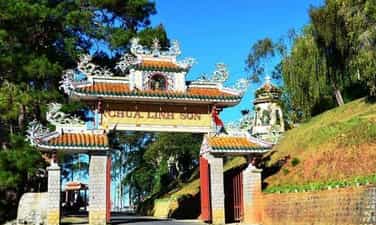
Linh Son Pagoda
Linh Son Pagoda is located on the hillside at 120 Nguyen Van Troi Street, in Ward 2, Da Lat City, and is one of the largest and oldest pagodas in Da Lat city. This is also where the headquarters of the Lam Dong Buddhist Association is located. The pagoda was built in 1938 at the request of Mrs. Tu Cung (King Bao Dai's mother) to the Trung Phan Sangha Guardian since 1936, after she returned from Da Lat to the capital Hue. Linh Son Pagoda was completed and put into use in 1940 by Venerable Thich Tri Thu. The pagoda is named after a mountain in India and has been restored and embellished many times. Linh Son Pagoda is located on a hill of nearly 4 hectares, and is a complex of many architectural works of different sizes. Linh Son Pagoda was built on a land area of about 4 hectares following the architectural characteristics of harmonious and simple Asian countries. The design here is influenced by the architecture of ancient pagodas in the Ancient Capital. Hue. On the top of the pagoda's roof, there is a very flying, winding dragon's tail. The main hall is arranged in a nail shape. The steps leading into the main hall have two dragons on both sides. Go through the three-entrance gate and follow the steps into the pagoda, surrounded by rows of tall star trees, pine trees and eucalyptus trees. Near the temple yard, there are brick pillars engraved with Buddha's teachings on both sides. In front of the temple yard is the statue of Avalokiteshvara Bodhisattva standing on a lotus throne. On the left side of the temple yard there is a lake with delicate rockeries and ornamental plants, on the right side is a three-storey octagonal stupa with a 4 meter high tiled roof. In the middle is the main hall consisting of two houses with both sides of the steps flanking a pair of dragons symbolizing the Dragon God protecting and upholding the Dharma. Inside the main hall of Linh Son Pagoda, the main hall is solemnly decorated. The front hall has four large wooden pillars carved with parallel sentences in Confucian characters painted in red and gilded with heavy spiritual meaning: In the middle is the altar of Shakyamuni Buddha sitting on a lotus. Above is a bronze statue weighing 1.25 tons and 1.7 meters high, cast in 1952, inaugurated under the testimony of Venerable Thich Tinh Khiet, President of the Vietnam General Buddhist Association. On the left side of the main hall is where the Patriarch hall worships Dat Ma Master To, and places the tablets of monks who have passed away or deceased people brought to the temple by their relatives so that their souls can be purified. Outside is a large drum 0.75 meters in diameter. On the right side of the main hall, there are statues of Dharma Protector Amitabha and Dai Hong Chung weighing 450 kg hanging on a precious wooden frame. In Linh Son Pagoda, there is also a scripture distribution room and a house of rebirth, a place to bury the bodies of Buddhists whose families want to hold funerals at the pagoda. In addition, Linh Son Pagoda also has a fairly large lecture hall built in 1972 and is currently the basic Buddhist school of Lam Dong province. Source: Lam Dong Province Buddhist Church
Lam Dong
5436 view
Rating : National monument
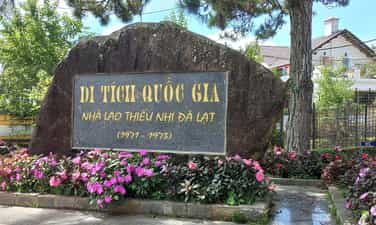
Da Lat Children's Prison
Da Lat Children's Prison was built by the old regime with the beautiful name: "Da Lat Children's Training Center". at No. 9A, Xuan Huong Lake, Da Lat city, Lam Dong province. This revolutionary historical relic was recognized by the Ministry of Culture, Sports and Tourism as a National Monument on June 22, 2009. "Da Lat Children's Education Center" was established in early 1971. The old regime used demagogy to deceive public opinion, covering up sinister plots to isolate, suppress, and eventually eliminate the elite. revolutionary spirit of the young generation in the South. This "center" is actually a children's prison, fully demonstrating the nature of an imperial prison. This special prison once detained more than 600 children from 12 to 17 years old with revolutionary spirit, gathered from all prisons in the South. The prison is designed as a closed rectangular block surrounded by stone walls. The two rows of houses along both sides are mainly cells and cells; The horizontal rows of houses create two courtyards in the middle to serve prisoners' activities when outside the cell. When allowed to sunbathe in the yard, prisoners are only allowed to move within small boxes marked on the yard adjacent to the entrance of each cell. In front is a normal A-shaped block, which is the office of the prison management apparatus. All activities of child prisoners are closed behind, within solid stone walls, with many rolls of thick barbed wire on the roof, only communicating with the outside through 2 layers of solid doors but barely always closed. Through the two doors of the A-shaped block is the flag yard area, the flagpole at that time permanently hung the flag of the Saigon government. Every morning at the beginning of the week, all child prisoners must gather here to salute the flag and sing the national anthem. Those who oppose, do not salute the flag, or sing the national anthem will be tortured until they submit. The prison has 8 cells, divided into 2 areas: the male prisoner area has 6 rooms and the female prisoner area has 2 rooms. Each room's area is about 30 square meters, usually holding 60 - 70 prisoners, with some rooms holding nearly 100 prisoners at peak times. At the end of the corridor of the two cell blocks are rows of solitary cells holding dissident soldiers. In particular, there was a stone cellar hidden behind the cell corridor, with no roof but only a thick barbed wire mesh on top for the enemy to carry out the dew and sun exposure punishment of prisoners. On April 23, 1971, the Saigon government sent 126 children prisoners from Ammunition Prison (Da Nang) to the Da Lat Children's Training Center, marking the official operation of this prison. After that, child prisoners from Hoi An, Quang Ngai, Binh Dinh, Phu Yen, Ben Tre... continued to be transferred; Especially at the end of 1971, the Saigon government gathered young revolutionary soldiers imprisoned in Con Dao prison and Chi Hoa prison to be detained here. From here, the young revolutionary soldiers gathered core forces, established a unified command, and set out specific demands to carry out continuous, persistent, and thorough fighting measures. the prison's existence process. During the struggle, even at a young age, child prisoners were still brutally abused and tortured in many forms: cross-cuffed, beaten with whips braided from electric wire, barbed wire, scout sticks, or Use a hot high-voltage electric bulb to press on your face... In the cell, in the middle of a cold Da Lat night, the temperature dropped below 15 degrees Celsius, the enemy also poured cold water to torture prisoners in solitary confinement. The young soldiers had to sleep on the cement floor, sharing each grain of rice, sip of water, bed... Young soldiers have also organized prison escapes seven times, expressing their desire for freedom and the desire to return to continue fighting. A shocking event at Da Lat children's prison on the evening of January 23, 1973 was when children prisoners organized to destroy prison guard Nguyen Cuong, who was willing to be a lackey for the enemy. It was the courageous and indomitable fighting movement of young revolutionary soldiers that failed the enemy's sinister plot to establish this prison, forcing it to disband in mid-1973. After the day of national reunification in 1975, former prisoners of Da Lat children's prison scattered to localities, continuing to promote the tradition of indomitable struggle in prison, actively contributing to the cause of building and preserving the country. protect the country. With particularly outstanding achievements in the cause of fighting the US to save the country, in 2009, the collective of former prisoners of Da Lat children's prison was awarded the title of Collective Hero of the People's Armed Forces by the President. The national relic of Da Lat Children's Prison (1971 - 1973) has now become a meaningful tourist destination in Lam Dong province. This is a "red address" in educating revolutionary ideals, patriotic traditions, and national pride for the young generation. Source: Lam Dong Museum
Lam Dong
9525 view
Rating : National monument
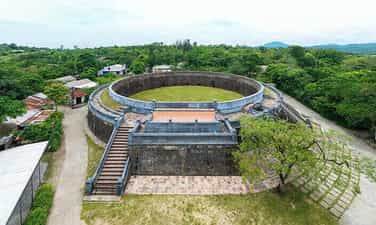
Ho Quyen Arena
Ho Quyen is an ancient arena, located in Truong Da village, Thuy Bieu ward, Hue city, Thua Thien Hue province. Here, life-and-death battles between elephants and tigers took place for the king and people to enjoy. These matches were both entertaining and a way for the court to train its soldiers. Before building the Ho Quyen arena, life-and-death battles between elephants and tigers during the Nguyen Dynasty were held on Da Vien island on the Perfume River. During this period, there were many dangerous incidents related to the match. In 1750, Lord Nguyen Phuc Khoat witnessed a bloody fight with 40 elephants slaughtering 18 tigers. In particular, a tiger slapped the mahout, then he was trampled to death by the elephant he trained. During the reign of King Minh Mang, while the king was watching the battle on the Perfume River, a tiger swam towards the dragon boat, luckily there was an army to protect him in time. Therefore, in the 11th year of Minh Mang, 1830, the king built a fortified arena in the land of Truong Da village, Nguyet Bieu village, west of the capital. Ho Quyen was built in a ring shape with two walls. The inner ring is 5.9m high, the outer ring is 4.75m high, inclined at a 15 degree angle to create a stable position. The perimeter of the outer wall is 140m, the diameter of the basin is 44m. Ho Quyen is embellished with bricks, lime mortar and fine stone. The grandstand is divided into two places, for the king, officials, people, and soldiers. The place where the king sat was located in the North, built higher than other locations. On the left are 24 steps for the royal family and ministers. The right side is for officials and soldiers of lower rank. Opposite the stands is a system of 5 tiger cages with wooden doors that open and close by pulling a rope from above. On the citadel wall, there is a door 8 meters high and 7 inches wide where elephants are brought into the arena. The ceremony of organizing the match between elephants and tigers at Ho Quyen is very solemn. Around the arena there are ceremonial staffs and flags. Soldiers holding weapons respectfully stood on both sides of the road, which had flower mats spread out to welcome the king. At noon, the king and his entourage will arrive in a dragon boat. When the boat was close to the riverbank, the king left the boat and went to a palanquin covered with four golden parasols and four golden ashes. Going in front will be the musketeers, behind in order will be the guards holding the three-colored flag, the five-element flag, the twenty-eighth flag, the drawn sword and finally the royal band. The death match at the Ho Quyen arena takes place every year and ends when the elephant kills the tiger. Ho Quyen was recognized as a national relic on September 26, 1998. Source: Thua Thien Hue tourism information portal
Hue
6844 view
Rating : National monument

Thien Mu Pagoda
Thien Mu Pagoda is the oldest pagoda in Hue, located on Ha Khe hill, on the left bank of the Perfume River. Thien Mu Pagoda is one of the most scenic spots in the ancient capital of Hue. The pagoda was built on top of a high hill right on the bank of the Perfume River opposite Nagarjuna land. In front of the pagoda's door is an octagonal architectural tower, an octagonal layout. This tower consists of 6 equal floors, but the higher you go, the smaller the area becomes. Each floor has a small roof protruding with decorative lines that are quite sophisticated, regular and unusually vivid. Each side has a fairly large rectangular rolling door but surrounded by many dragon and moon models. At the top is a small 8-sided roof. In the middle is decorated a wine barrel with a pointed nose. There are patterns of clouds all around. Legend has it that, when Lord Nguyen Hoang became governor of Thuan Hoa and governor of Quang Nam, he personally went to examine the terrain here to prepare for his plan to expand his business and build a country for his lineage. later Nguyen family. Once, while riding his horse's hooves along the banks of the Perfume River upstream, he came across a small hill rising next to the meandering clear blue water. The ground looked like a dragon turning its head to look back. This hill has The name is Ha Khe hill. Local people said that at night, an old woman wearing a red shirt and green pants often appears on the hill and tells everyone: "Someday, a true lord will come and build a pagoda to gather spiritual energy and strengthen the temple." Dragon veins, for a strong South country". Therefore, this place is also called Thien Mu Son. Lord Nguyen Hoang's great thoughts seem to be in tune with the will of the people. Nguyen Hoang was so happy that in 1601 he built a pagoda on a hill, facing the Perfume River, naming it "Thien Mu". With its expanded scale and natural beauty, Thien Mu Pagoda has become the most beautiful pagoda in Dang Trong. Through many historical ups and downs, Thien Mu Pagoda was once used as a Dat Sacrifice altar under the Tay Son Dynasty (around 1788), then was restored and rebuilt many times under the Nguyen Dynasty. In 1884, on the occasion of celebrating the "eighth birthday" (80th birthday) of Queen Thuan Thien Cao (King Gia Long's wife, King Thieu Tri's grandmother), King Thieu Tri re-architected the pagoda properly. bigger: Build Tu Nhan tower (later changed to Phuoc Duyen tower), Huong Nguyen communal house and erect two steles recording the king's poetry. The pagoda campus is divided into two areas: The area in front of Nghi Mon gate includes architectural works: The boat wharf has 24 steps up and down, the three-entrance gate is four pillars built close to the main road, from the three-entrance gate. Stepping up 15 steps is Huong Nguyen communal house (now only the ground floor and solid stone foundation remains). Behind Huong Nguyen communal house is the Phuoc Duyen tower built of seven-storey high-height bricks. On both sides of Huong Nguyen communal house, there are two The stele building is quadrangular in shape (built during Thieu Tri's reign), back inside there are two hexagonal shaped floors, one for stele and one for bells (built during Nguyen Phuc Chu). These are memorial works (steles, towers). The area inside Nghi Mon gate includes Dai Hung palace, Dia Tang palace, Quan Am palace, Trai house, Guest house, flower garden, and at the back is a quiet pine garden. Thien Mu Pagoda is like a witness of history taking place on the banks of the Perfume River. The pagoda still exists in the minds of Hue people in particular and the cultural life of Vietnamese people in general. Source: Vietnam National Tourism Administration
Hue
8381 view
Rating : National monument

Gia Long Tomb
Gia Long Tomb is located in the Thien Tho mountain range, in Huong Tho commune, Huong Tra district, Thua Thien Hue province, 16km from Hue City center. Gia Long Tomb is a complex of many royal tombs. The mausoleum's architecture seems simple but majestic. This entire mausoleum area is a mountain complex with 42 hills, large and small mountains, of which Dai Thien Tho is the largest mountain chosen as the forecourt of the mausoleum and is the name of this entire mountain complex. Construction of the mausoleum began in 1814 and was completed in 1820. From the bank of the Perfume River to the mausoleum, there is a wide path, with tall, green pine trees and winter melon trees on both sides, creating a cool, quiet atmosphere. Two majestic pillars are located on the outside, signaling the mausoleum area. The king's mausoleum is located on a large, flat hill. Before, there is Dai Thien Tho mountain as a backdrop, then there are 7 mountains as a backdrop. On the left there are 14 mountains as "left dragon" and on the right there are 14 mountains as "right white tiger". The overall mausoleum is divided into 3 areas: In the middle is the tomb of the king and Queen Thua Thien Cao. Beyond the adoration yard, there are rows of majestic stone statues and seven levels of the worship yard, the Precious Saint at the top of the hill. In Buu Thanh, there are 2 stone tombs created according to the concept of "The Virtuous Universe" symbolizing happiness and fidelity. On the right is the palace area, of which Minh Thanh Palace is the center where the first Emperor and Empress are worshiped. Previously, in Minh Thanh Palace, there were many memorabilia associated with Gia Long's war life. On the left side of the mausoleum is Bi Dinh, now only the large stele with the song "Holy Duc Than Cong" composed by King Minh Mang, praising his father, is delicately and sharply carved. There are also neighboring mausoleums in this area such as Quang Hung mausoleum (second wife of Lord Hien Vuong Nguyen Phuc Tan), Vinh Mau mausoleum (wife of Lord Ngai Vuong Nguyen Phuc Tran); Toai Thanh mausoleum (second wife of Nguyen Phuc Luan and Gia Long's mother),... Thien Tho Huu mausoleum of Mrs. Thuan Thien Cao Queen, mother of King Minh Mang, next to it is Gia Thanh palace used for worship. Gia Long Tomb is a wonderful picture between nature and architecture that creates the majestic grandeur of the landscape. King Gia Long's real name is Nguyen Phuc Anh, his last name is Chung, born in 1762, the third child of Nguyen Luan. In 1773, the Tay Son revolted, 12-year-old Nguyen Phuc Anh followed Lord Nguyen Phuc Thuan to Quang Nam. In the fall of the year of the Rooster (1777), Nguyen Phuc Thuan died in battle, Nguyen Phuc Anh escaped alone to Tho Chu island, and then fled to Siam for refuge. In July 1792, King Quang Trung died, his son Quang Toan was still young. Nguyen Phuc Anh organized an attack and destroyed the Tay Son dynasty. He ascended the throne, took the reign name Gia Long, established the capital in Phu Xuan citadel (Hue) and named the country Vietnam. On Dinh Mui day, December of Ky Mao year (1819), Gia Long died at the age of 59, on the throne for 25 years, on the throne for 17 years. Gia Long Tomb (also known as Thien Tho Lang) is the resting place of the first king who founded the Nguyen Dynasty. Source: Vietnam National Administration of Tourism
Hue
4609 view
Rating : National monument